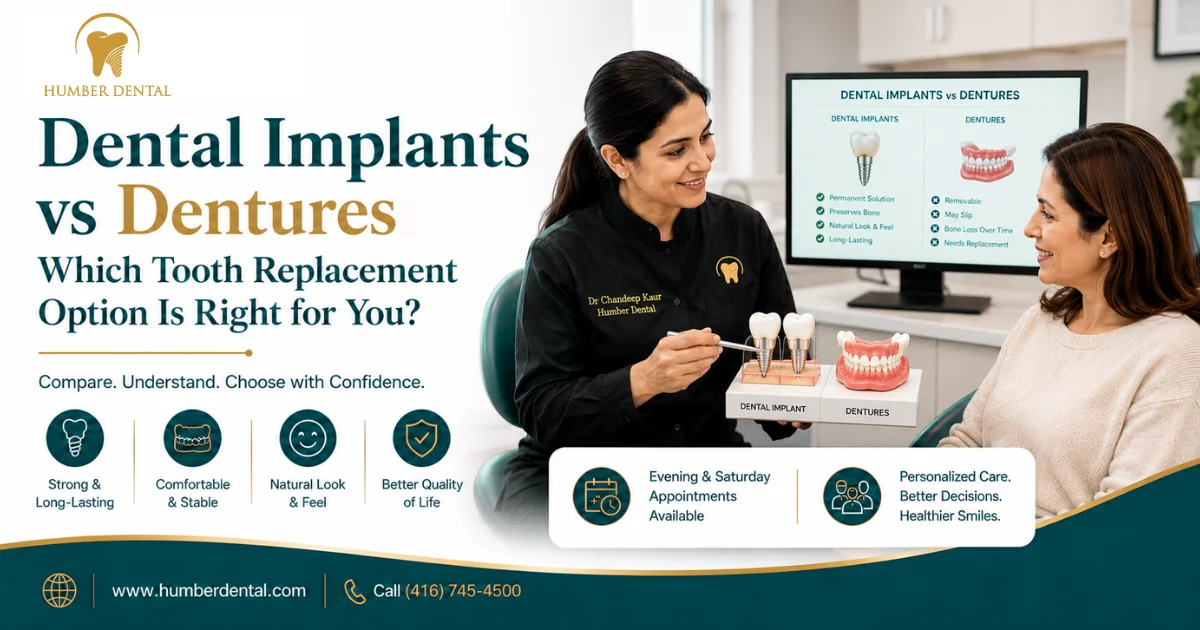
| Neither one wins for everyone. Dental implants are fixed, feel like natural teeth, and help protect your jawbone, but they cost more and take a few months to place. Dentures are cheaper and faster and can replace many teeth at once, though they can shift, need relines, and don’t stop bone loss. For one or a few teeth, implants usually win in comfort. For a full mouth on a tight budget, dentures make sense. The right pick depends on your teeth, health, and budget, and it’s confirmed at a consult. |
If you’re missing teeth, you’ve probably had the same two words thrown at you: implants or dentures. And if you’ve searched for implants vs dentures, you’ve likely found strong opinions in both camps and little nuance.
Here’s the nuance. Both are good tools. They just solve the problem differently, and the better one depends entirely on your mouth and your priorities. Let’s compare them as we would sitting across from you.
The Real Difference, In One Line
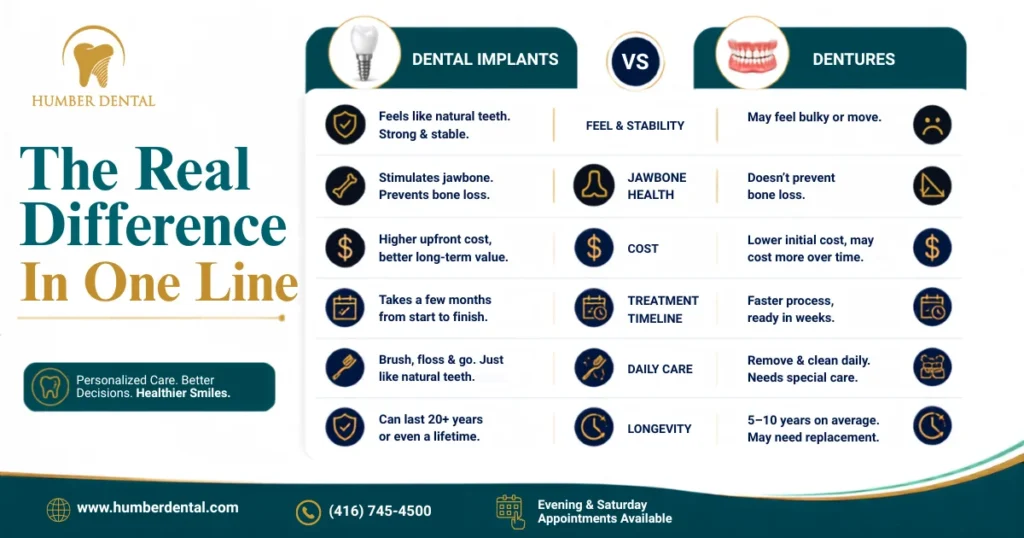
An implant is fixed in place and replaces the tooth’s root. A denture sits on the gums and can be removed. That single distinction, anchored versus removable, drives almost every difference that follows.
| What matters | Dental implants | Dentures |
|---|---|---|
| Feel and stability | Fixed; feels like natural teeth | Removable; can shift or click |
| Jawbone | Help preserve the bone | Do not stop bone loss |
| Upfront cost | Higher | Lower |
| Timeline | A few months | A few weeks |
| Daily care | Brush and floss like teeth | Take out and clean nightly |
| Longevity | Often decades | Relines and remakes over time |
Where Implants Shine
If comfort and permanence are what you’re after, this is where implants pull ahead. They don’t move when you eat or laugh, there’s nothing to take out at night, and because they replace the root, they keep stimulating the jawbone. For a single gap or a few teeth, most people find the everyday experience is simply better. When patients ask us about tooth replacement options for one visible tooth, implants are usually the first thing we reach for.
Where Dentures Still Make Sense
Dentures get an unfair reputation. They’re far kinder on the budget up front, they’re quicker, and modern ones fit and look better than the pair you might remember on a grandparent’s bedside table. For a full mouth, for someone who isn’t a surgical candidate, or when cost is the deciding factor, a well-made denture is a genuinely good answer, not a consolation prize.
| 🩺 Clinical Note: The quiet cost of a removable optionHere is the trade-off people rarely hear about up front: because a denture sits on the gums and doesn’t replace the root, the underlying jawbone slowly shrinks. Over the years, that’s why dentures need relines and can start to feel looser. It doesn’t make them the wrong choice, but it is worth knowing when you weigh the long game against the upfront savings. |
There Is a Middle Ground
It isn’t strictly one or the other. Implant-supported dentures snap onto a small number of implants, giving you much of the stability of individual implants at a lower cost than a full set. For a lot of people, this is the sweet spot: no slipping, no adhesive, and a friendlier price than replacing each tooth individually.
What About Replacing Multiple Missing Teeth?
This is where the choice gets interesting. For replacing multiple missing teeth, you’re not limited to a full denture. A couple of implants can support a fixed bridge, or a full arch can be supported by just four to six implants. The right mix depends on how many teeth are gone and where, which we map out with a scan. Our guide to the types of dental implants breaks down each setup.
So, Which Is Right for You?
Be straight with yourself about your top priority. If it’s long-term comfort and bone protection, implants usually justify their higher cost. If it’s getting a full, natural-looking smile back quickly and affordably, a denture may be exactly right. There’s no universal winner, only the right fit for you, and a quick exam settles it fast. If you’d like the numbers side by side too, our breakdown of dental implants in Etobicoke and our cost guide help.
Weigh Your Options With Us in Etobicoke
Not sure which way to lean? That’s what a consultation is for. We’ll look at your teeth, talk through the trade-offs in plain terms, and help you choose the option you’ll be happy with in five years to come, and not just five minutes.
📞 Call: (416) 745-4500
🌐 Online: humberdental.com
📍 Visit: 6100 Finch Ave W, Unit 205 & 206, Etobicoke, ON M9V 0A1
Evening and Saturday appointments available.
FAQs About Implants vs Dentures
Q1. Are implants better than dentures?
Not universally. Implants tend to win on comfort, stability, and bone health, while dentures win on upfront cost and speed. The better option depends on your teeth, health, and budget.
Q2. Are dentures cheaper than implants?
Yes, usually by a fair margin up front. That’s a big reason people choose them, especially for a full mouth. Implants often cost more now but can last longer.
Q3. Can dentures be as stable as implants?
A standard denture can shift. Implant-supported dentures, which snap onto a few implants, get much closer to implant stability while staying more affordable than a full set of single implants.
Q4. What’s best for replacing multiple missing teeth?
It depends on how many and where. Options range from a fixed bridge on a couple of implants to a full arch on four to six implants, to a partial or full denture. A scan clarifies the best fit.
Q5. Do dentures cause bone loss?
Dentures don’t cause it, but they don’t prevent it either. Because they don’t replace the root, the jawbone keeps slowly shrinking, which is why relines are sometimes needed over time.
Q6. Can I switch from dentures to implants later?
Often, yes, though long-term bone loss can make it more involved. If implants might be in your future, it’s worth raising early so we can plan around them.