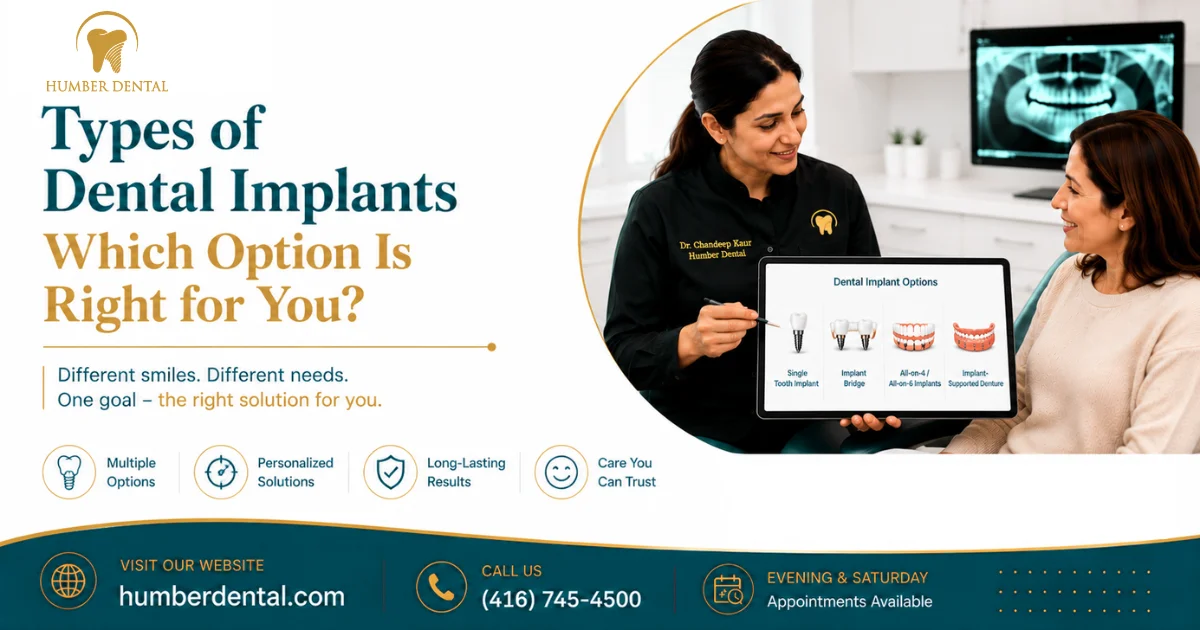
| The main types of dental implants are grouped by how many teeth they replace: a single implant for one tooth, an implant bridge for a few, a full-arch set (All-on-4 or All-on-6) for a whole jaw, and implant-supported dentures for a removable option. Most use a titanium post placed in the bone, with zirconia as an alternative. The best dental implant for your missing teeth depends on how many teeth are missing, your bone, and your budget, as confirmed during a consult. |
“Dental implant” sounds like a single product. It isn’t. When people start looking into the types of dental implants, they’re often surprised by how many options exist and how different the right one can be from person to person.
The good news is that it isn’t complicated once you frame it the right way. Almost every choice comes down to one question: how many teeth are you replacing?
Grouped by How Many Teeth You’re Replacing
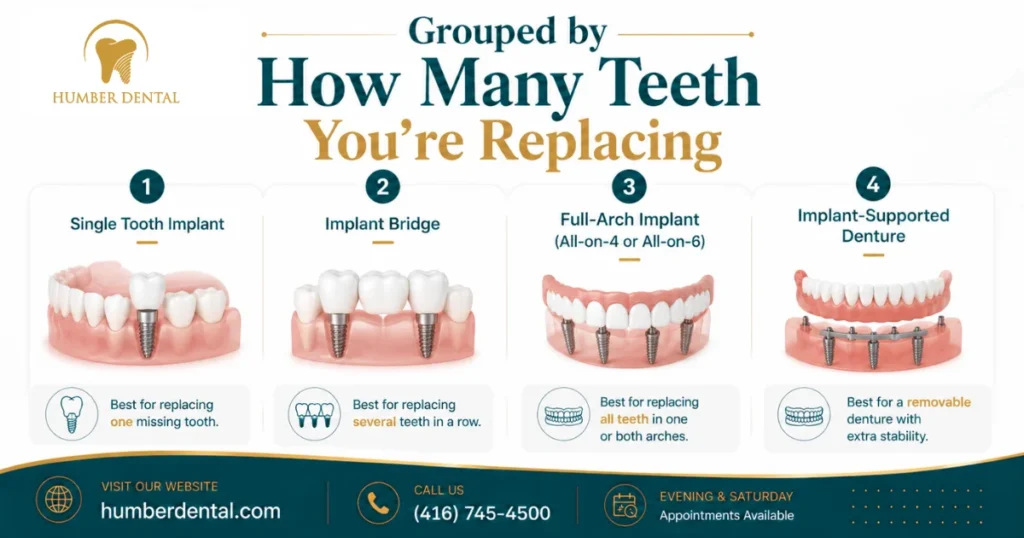
This is the most useful way to think about your dental implant options, because it maps straight onto real situations.
| Option | Best suited to | In short |
|---|---|---|
| Single implant | One missing tooth | One post, one crown, stands on its own |
| Implant bridge | A few teeth in a row | Two implants carry several teeth |
| Full arch (All-on-4/6) | Most or all teeth in a jaw | A fixed set of 4 to 6 implants |
| Implant denture | A removable full-arch option | A denture that snaps onto implants |
Single Implant
One post, one crown. It’s the classic fix for a single gap, and it leaves your neighbouring teeth completely untouched, which a traditional bridge can’t say.
Implant Bridge
When a few teeth in a row are missing, you don’t need one implant per tooth. Two well-placed implants can carry a small bridge, which is gentler on your budget and just as fixed.
Full-Arch (All-on-4 or All-on-6)
When most or all of an arch is gone, a full set of fixed teeth can be supported by just four to six implants. It’s a bigger procedure, but life-changing for anyone tired of a loose full denture.
Implant-Supported Denture
Prefer something removable, or working with a tighter budget? A denture that snaps onto a couple of implants ends the slipping and adhesive routine while costing less than a full set of single implants.
Grouped by Design and Material
There’s a second layer, and you don’t need to memorise it, but it helps to recognise the terms. Most implants are endosteal, meaning the post sits in the jawbone itself. A less common design, subperiosteal, rests on the bone under the gum and is reserved for specific situations, usually when there isn’t enough bone for the standard approach.
In materials, titanium is the long-proven standard: strong and readily bonded to bone. Zirconia is a newer, metal-free alternative that some patients prefer for its tooth-coloured look. Both are among the well-tested kinds of dental implants, and we’ll talk through which suits your case.
| 🩺 Clinical Note: There’s rarely one right answer Two people missing the same tooth can still be better suited to different options, because bone, budget, and what’s happening with the neighbouring teeth all matter. That’s why the best dental implant for missing teeth is decided after a scan and an exam, not from a chart. The aim is the option you’ll be happiest with for years, not just the one that fits today. |
So, Which Type Is Right for You?
Start with how many teeth you’re replacing, then let your bone, budget, and goals narrow it down. If you want to see how the costs compare across these setups, our dental implant cost guide lines them up, and if you’re still weighing implants against a removable plate, our implants vs dentures comparison helps.
Explore Your Options in Etobicoke
The cleanest way to find your fit is a quick assessment. Book a consult for dental implants treatment in Etobicoke, and we’ll scan, examine, and walk you through the options that genuinely suit your mouth, in plain terms and with no pressure.
Call: (416) 745-4500
Online: humberdental.com
Visit: 6100 Finch Ave W, Unit 205 & 206, Etobicoke, ON M9V 0A1
Evening and Saturday appointments available.
FAQs About Types of Dental Implants
Q1. What are the main types of dental implants?
They’re grouped by how many teeth they replace: a single implant, an implant bridge for a few teeth, a full-arch set on four to six implants, and implant-supported dentures for a removable option.
Q2. What’s the best dental implant for missing teeth?
It depends on how many teeth are gone, your bone, and your budget. A single implant suits one gap, while full-arch options suit a whole jaw. A scan confirms the best fit.
Q3. What are implants made of?
Most use a titanium post, which is strong and bonds well with bone. Zirconia is a newer, metal-free, tooth-coloured alternative that some patients prefer. Both are well-established.
Q4. What’s the difference between endosteal and subperiosteal implants?
Endosteal implants sit in the jawbone and are by far the most common. Subperiosteal implants rest on the bone under the gum and are used in specific cases, usually when bone is limited.
Q5. Do I need one implant per missing tooth?
No. A few implants can carry a bridge, and a full arch can sit on just four to six implants, which is far more cost-effective than replacing every tooth individually.
Q6. How do I know which type I need?
An exam and a 3D scan. They show how many teeth are involved and how much bone you have, which together point to the right option for you.