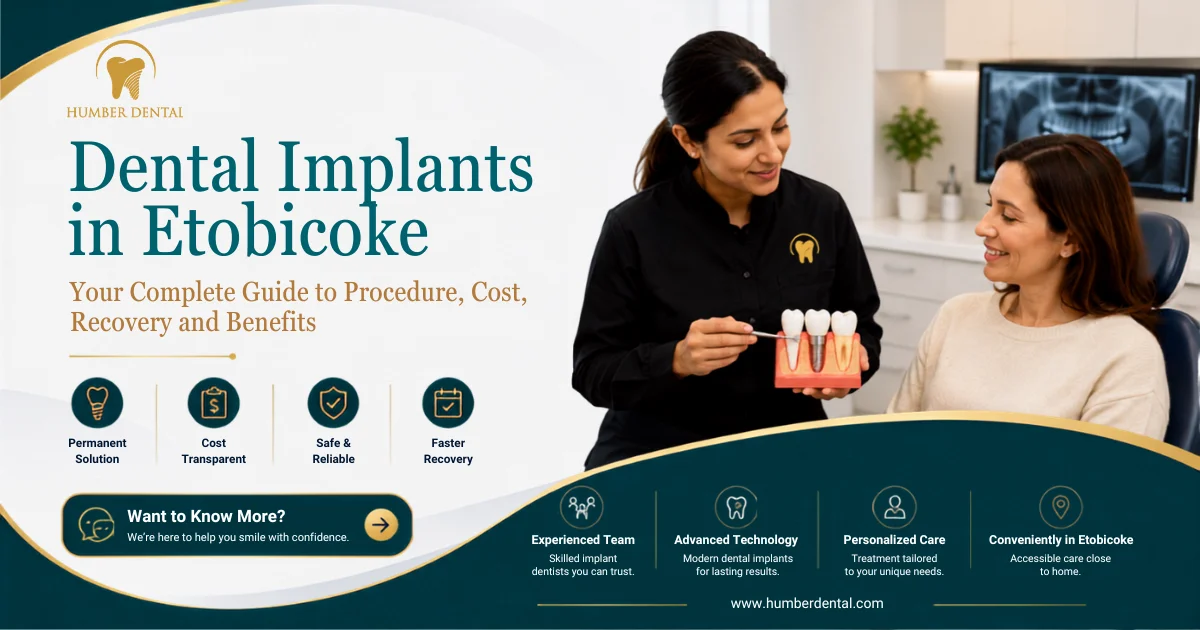
| A dental implant is a small titanium post that replaces the root of a missing tooth. A crown sits on top, and the result looks and works like the real thing. In Etobicoke, a single implant usually runs about $3,000 to $6,500, and the whole process takes a few months, because the bone needs time to heal around the post. Most people find it far less of an ordeal than they feared, and implants can last for decades when they’re looked after. The one catch: not everyone is a candidate on day one, so it always starts with an exam. |
Let us start with the sentence we hear most often.
“I have been putting this off for years.”
Usually it’s about a missing tooth, or a couple of them, or a denture that has never quite felt right. People sit down a little embarrassed, half expecting a lecture. They don’t get one. Losing teeth is common, replacing them is routine, and dental implants have quietly become the closest thing modern dentistry has to a real, natural tooth.
This is the long version of the answer, the one we wish we had time to give every patient in the chair. What an implant actually is. How the procedure goes, start to finish. What it costs here in Etobicoke, in real numbers. How long healing really takes, and who it suits. No pressure and no sales pitch, just the full picture so you can decide what happens next on your own terms. If you have been searching for dental implants in Etobicoke and want the full picture before committing to anything, you are in the right place.
So, What Is a Dental Implant, Really?
Forget the word “implant” for a second. Think of a tooth as two pieces: the root you never see, anchored in bone, and the crown you do see when you smile. When a tooth is lost, the crown is the obvious missing part. But the root matters just as much, and that’s exactly the part dentures and bridges leave out.
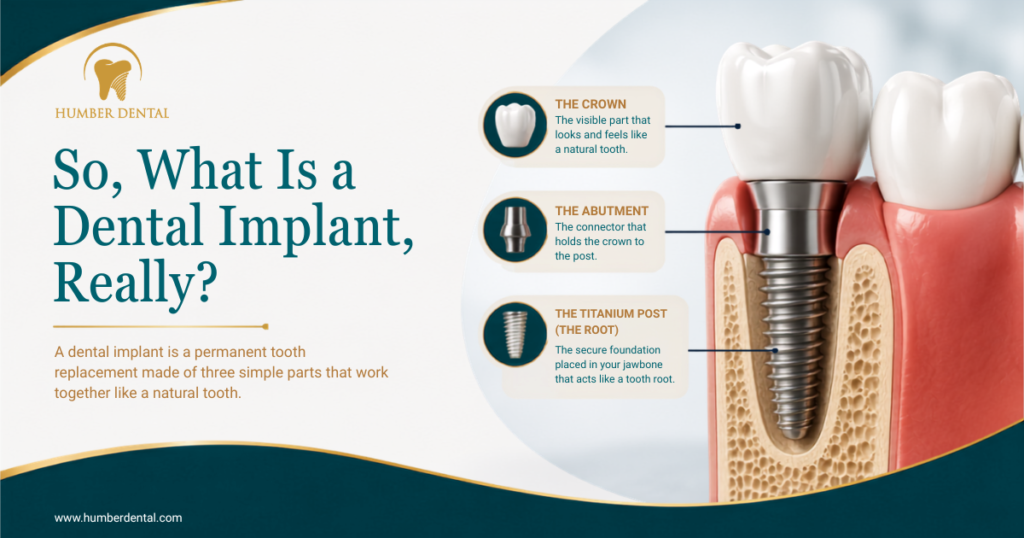
An implant replaces the root. It’s a small, screw-shaped post, almost always titanium, placed into the jawbone where the old root used to sit. Over a few months the bone grows tightly around it. There’s a name for that, osseointegration, and it’s the whole reason implants work. Once the post is solid, we attach a connector called an abutment, and then a custom crown goes on top.
Three parts, then. The post in the bone, the abutment in the middle, the crown you see. Titanium, because the body accepts it well and bone bonds to it. That’s it. That’s the whole idea, and in principle it has barely changed since the 1960s, even as the tools have become far more precise. In plain terms, tooth implants treatment rebuilds a lost tooth from the root up, which is why it tends to feel and work like the real thing.
Who Actually Ends Up Getting Implants?
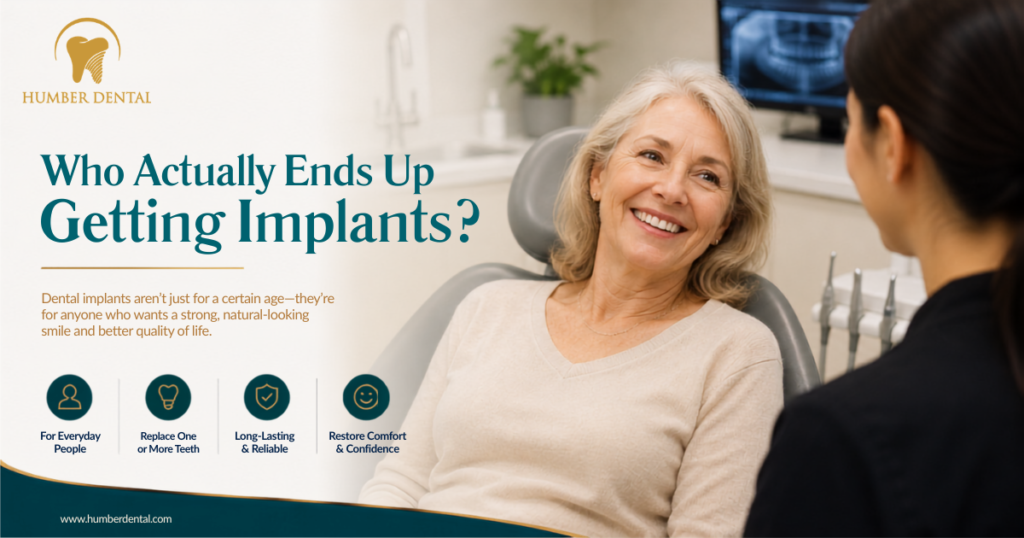
The real answer is more people than you’d guess, and often not the people you’d guess.
Yes, we place implants for patients missing a single tooth after a crack or a failed root canal. But we also see people who have worn a partial denture for a decade and are tired of it shifting, folks who lost a few teeth years ago and quietly learned to chew on one side, and adults in their sixties and seventies who have simply decided they’re done hiding their smile in photos. Missing tooth replacement isn’t a young person’s concern or an old person’s concern. It’s just common.
And a gap isn’t only cosmetic. Here’s the part most people don’t expect. When a root is gone, the jawbone beneath it stops getting the steady pressure it’s used to from chewing, and it slowly begins to shrink. Some research points to meaningful bone loss in just the first year after a tooth comes out. That shrinking can quietly change your bite, let neighbouring teeth drift, and over time even alter the shape of your face. Implants are the one everyday option that puts a root back, which is why they help hold that bone in place.
Your Options: One Tooth, A Few, or A Whole Arch
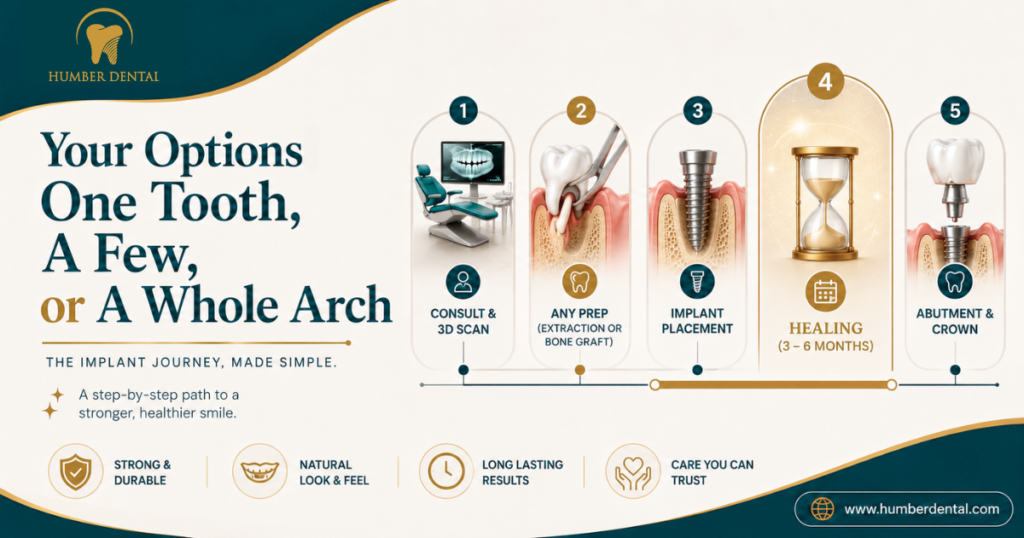
“Dental implant” sounds like a single thing. It isn’t. What’s right for you depends on how many teeth are missing, and where.
For one gap, it’s one implant and one crown. Simple.
For several missing teeth in a row, you often don’t need an implant for every single one. A couple of well-placed implants can anchor a small bridge, which is gentler on both your budget and your jaw. And when most or all of an arch is gone, there are full-arch options, sometimes called All-on-4 or All-on-6, where a fixed set of teeth rests on just four to six implants. Would you rather have something removable? Implant-supported dentures snap onto a few implants and put an end to the slipping that drives denture wearers up the wall. We go deeper in our guide to the types of dental implants , but the headline is this: there’s rarely just one way to fix your particular mouth.
What the Procedure Is Actually Like
This is the part people brace themselves for, so let us walk it slowly.
It starts with a conversation and a scan, not a drill. We look at your teeth, take a 3D image of the bone, and work out whether there’s enough of it to hold an implant. Sometimes there isn’t, and a bone graft or a sinus lift is added to build the site up first. That’s normal, not a red flag.
If a damaged tooth is still in the way, it comes out. Then the implant itself: a minor surgery, usually under local anesthetic, where the post is placed into the bone. Most patients tell us afterward that it was less eventful than an extraction they had years earlier. You’re numb, it’s quicker than you expect, and you go home the same day.
Then you wait. This is the part that catches people off guard, because it isn’t instant. The bone needs roughly three to six months to fuse around the post, and longer if you’ve had a graft or if you heal more slowly. We aren’t being cautious for the sake of it. Rush this stage and the implant can fail, so the waiting is doing real work.
Once the post is solid, the finish line comes fast. We attach the abutment, take an impression, and place your custom crown. You walk out chewing on it.
| 🩺 Clinical Note: Why the wait mattersThat three to six month healing window is the single most important part of implant success. During it, bone cells physically grow onto the titanium and lock the post in place. Studies that follow implants over ten years commonly report success rates around 95 percent or higher, and that reliability comes largely from not rushing this stage. Your own timeline depends on your health, the site in your mouth, and habits like smoking, which slows healing. |
Healing: The Real Timeline

Recovery has two chapters, and they’re very different lengths.
The first is short. For the first two or three days after placement, expect some swelling and perhaps a little bleeding, the sort of thing an ice pack and the pain relief we recommend handle easily. Most people are back at work the next day or the one after. Stick to soft foods for a bit, keep the area clean, and try not to poke at it. Swelling tends to peak around day two or three, then settles.
The second chapter is the long, quiet one: those months of healing happening invisibly under the gum while you get on with your life. You won’t feel it. You’ll just come in for the odd check so we can confirm it’s tracking well. If something does feel off, pain that lingers past the first week, swelling that climbs instead of fading, or an implant that feels loose, that’s worth a call, not a wait. Our full dental implant recovery guide walks through it week by week, but the reassuring truth is that most healing is uneventful and frankly a bit boring, which is exactly what you want it to be.
What Dental Implants Cost in Etobicoke
Here’s where we try to be a little more upfront than the average website.
There’s no single price, and anyone who quotes you one before an exam is guessing. What we can give you’re real ranges for the Etobicoke and wider Toronto area, so you can plan without a nasty surprise later.
| Implant option | Typical Etobicoke range (CAD) | What it usually covers |
|---|---|---|
| Single implant | $3,000 to $6,500 | One post, abutment, and crown |
| Several teeth (implant bridge) | $6,000 to $15,000 | A few implants anchoring a bridge |
| Full arch (All-on-4 or All-on-6) | $25,000 to $40,000+ per arch | A fixed set of teeth on 4 to 6 implants |
| Implant-supported denture | $8,000 to $25,000 per arch | A removable denture that snaps on |
A few things worth knowing. Those figures usually bundle the post, abutment, and crown, but not always, so ask what’s included. Extras sit on top: a bone graft can add $300 to $3,000, a sinus lift $1,500 to $3,000, plus sedation or 3D imaging if you need them. And the dental implants cost you’re quoted reflects your specific mouth, not a menu price. Insurance is a mixed bag, OHIP doesn’t cover implants and many private plans treat them as major or cosmetic work, so any coverage is often partial. The better news: we help you check your benefits, and interest-free payment plans can turn one big number into a manageable monthly one. Our full breakdown of dental implant cost goes through it factor by factor.
Why People Choose Implants
So why go through all of this instead of a simpler denture or bridge? A handful of reasons come up again and again in our chairs.
- They Feel Like Your Own Teeth. Because the post is anchored in bone, an implant doesn’t slip, click, or come out at night. You bite into an apple and forget it’s there, which is about the highest compliment an implant can get.
- They Protect Your Jaw. This is the quiet one. By replacing the root, an implant keeps stimulating the bone and helps prevent the shrinking that follows tooth loss. No other everyday option really does that.
- They Leave Your Other Teeth Alone. A traditional bridge needs the healthy teeth on either side filed down to hold it. An implant stands on its own and doesn’t touch them.
- They Last For Decades. With decent care, implants are measured in decades, not years. That’s a big part of why, dollar for year, the benefits of dental implants often outweigh the higher cost up front.
Implants vs the Alternatives
None of this means an implant is automatically the right answer for everyone. Dentures are far cheaper up front and are sometimes the sensible call, especially for a full mouth or a tight budget. A bridge can be quicker when the neighbouring teeth already need crowns anyway. The trade-offs are real: dentures can move and need relines, bridges lean on other teeth and don’t stop bone loss, and implants cost more and take longer but tend to win on comfort and longevity. If you’re actively weighing a plate against a post, our side-by-side on dental implants versus dentures lays it out plainly.
Are You Actually a Candidate?
Most healthy adults are, but not all, and being straight here saves everyone disappointment later.
The three things we look at are simple: enough healthy bone to hold the post, healthy gums to surround it, and general health good enough to heal well. Uncontrolled diabetes, heavy smoking, and some medications can complicate matters, not always ruling implants out, but sometimes changing the plan. Age on its own almost never does; we place implants for people well into their seventies and eighties. If the bone isn’t there yet, grafting can often build it up. If your gums need attention first, we sort that out before anything goes in. The only way to know your answer is an exam, which is the genuine reason we can’t give you a real quote over the phone.
If You Decide to Move Forward
There’s no rush. But if you want to take the next step, here’s what it looks like. You book a consult. We examine your mouth, take the 3D scan, and tell you plainly whether implants suit you and what it would involve. You leave with a written plan and a real number, not a vague estimate. We check your insurance with you and, if cost is a hurdle, walk through interest-free payment options. Then you decide, on your timeline, not ours.
Talk to an Implant Dentist in Etobicoke
If that missing tooth has been sitting at the back of your mind, a consultation is the low-pressure place to start. Come in, ask us anything, and leave knowing your options. Whether you want a single tooth sorted or a whole arch rebuilt, we’ll give it to you straight. As your implant dentist in Etobicoke, our job at that first visit is to give you a real answer, not a sales pitch.
📞 Call: (416) 745-4500
🌐 Online: humberdental.com
📍 Visit: 6100 Finch Ave W, Unit 205 & 206, Etobicoke, ON M9V 0A1
Evening and Saturday appointments available, so implant care doesn’t have to cost you a day off work.
FAQs About Dental Implants in Etobicoke
Q1. What exactly is a dental implant?
It’s a small titanium post that replaces the root of a missing tooth. A connector (the abutment) and a custom crown go on top, so the finished result looks and works like a natural tooth.
Q2. How much do dental implants cost in Etobicoke?
As a rough guide, a single implant runs about $3,000 to $6,500, and full-arch options run much higher. Extras like bone grafts sit on top. Your real number comes from an exam, not a phone call.
Q3. Does getting an implant hurt?
Less than most people fear. Placement is done under local anesthetic, and patients often say it felt easier than a tooth extraction. Expect mild swelling and soreness for a few days afterward, managed with ice and simple pain relief.
Q4. How long does the whole process take?
Usually a few months. The post is placed, then the bone needs about three to six months to fuse around it before the final crown goes on. Grafting adds time. It’s a slow step for a good reason.
Q5. How long do dental implants last?
With good care, often decades. The crown may need replacing eventually, but the implant itself is built to be a long-term solution. Daily brushing, flossing, and regular check-ups make the biggest difference.
Q6. Am I too old for dental implants?
Almost certainly not. Age on its own is rarely the deciding factor; your bone, gums, and general health matter far more. We place implants for patients well into their seventies and eighties.
Q7. Does OHIP or the CDCP cover implants?
OHIP doesn’t cover dental implants, and coverage under public and private plans is usually limited, since implants are often treated as major work. We’ll help you check your benefits and look at payment plans either way.
Q8. What if I don’t have enough bone?
That’s common, and often fixable. A bone graft or sinus lift can build the site up first, which adds some time but makes a strong, lasting implant possible. The scan at your consult tells us what you need.