A father recently came in with his twelve-year-old daughter, certain they had “missed the window” for braces, and quietly wondering, after years of hiding his own crooked smile in photos, whether anything could still be done for him. By the end of the visit, both had a clear path forward: a watch-and-monitor approach for his daughter’s still-developing jaw, and discreet clear aligners for him. Neither had realized how much orthodontics had changed.
This is one of the most common conversations we have at Humber Dental. Many people still assume orthodontic care is only for teenagers, only about appearance, or only available as a mouthful of metal. None of that is true anymore. Whether you are a parent weighing your child’s options or an adult who has thought about it for years, this guide explains, in plain language, what orthodontic care in Etobicoke involves today: the signs that treatment may help, your options, what it typically costs, the benefits, and how to take a sensible first step.
Orthodontic Care in 60 Seconds
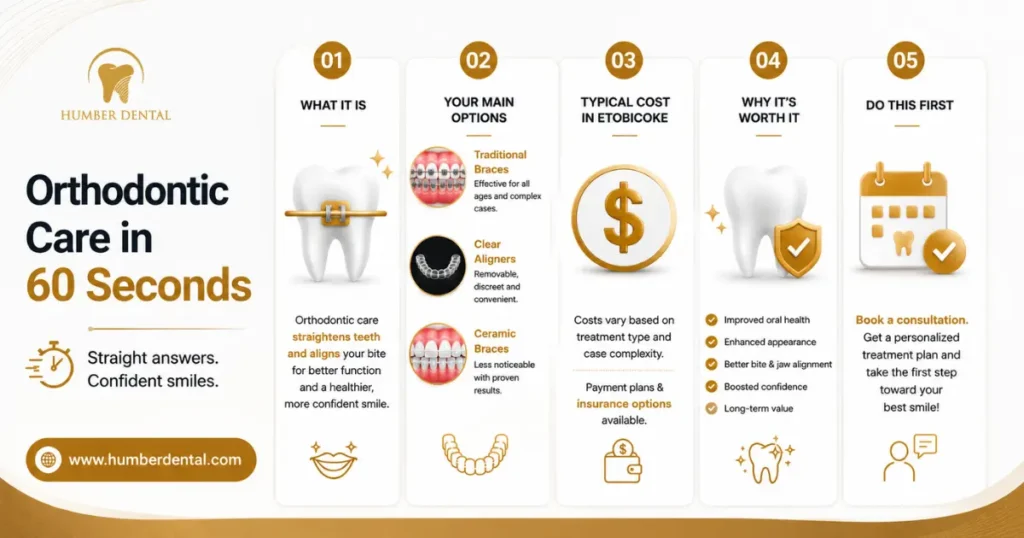
What it is. Orthodontic care straightens teeth and corrects how the upper and lower teeth fit together (your bite), for children, teens, and adults alike.
Your main options. Traditional metal braces, more discreet ceramic or lingual braces, and removable clear aligners such as Invisalign. The right fit depends on your case, lifestyle, and budget.
What it typically costs. In the Etobicoke area, braces generally range from about $3,000 to $7,500 and clear aligners from about $4,000 to $8,500. These are general ranges; your exact cost is confirmed at a consultation.
Is it worth it? Beyond appearance, straighter teeth are easier to clean and a balanced bite can be gentler on your jaw over time.
Do this first. Book an assessment to learn which option suits your teeth, and ask about insurance coverage and interest-free payment plans before you decide.
What Is Orthodontic Care?
Orthodontics is the area of dentistry focused on the position of the teeth and jaws: specifically, diagnosing, preventing, and correcting teeth that are misaligned or bites that do not fit together properly. Where general dentistry keeps your teeth healthy, orthodontic treatment is about guiding them into a better position so they both look and function better.
It is also for almost everyone. Children can benefit from early assessments that monitor growing jaws, teens are the classic candidates, and adults now make up a sizeable and growing share of orthodontic patients. Thanks to modern options like clear aligners and tooth-coloured braces, orthodontic treatment in Etobicoke today is more discreet and comfortable than the experience many people still picture.
Signs You May Benefit From Orthodontic Treatment
Some reasons to see a dentist or orthodontist are obvious; others are easy to live with for years. You may be a candidate for an assessment if you notice any of the following:
- Crowded, overlapping, or visibly crooked teeth
- Noticeable gaps or spacing between teeth
- Upper and lower teeth that do not meet properly when you bite
- A jaw that clicks, pops, or aches, or frequent jaw tension
- Difficulty chewing, or regularly biting your cheek or tongue
- Teeth that look worn down, possibly from grinding
- A bite that simply feels “off”
These are signals to get checked, not a diagnosis. Only an in-person examination can confirm whether treatment is needed and what would help. If any sound familiar, it is worth booking an assessment with a dentist or orthodontist in Etobicoke. For a closer look at specific bite issues, see our guide to common bite problems and how they’re treated
Common Bite Problems Orthodontics Can Correct
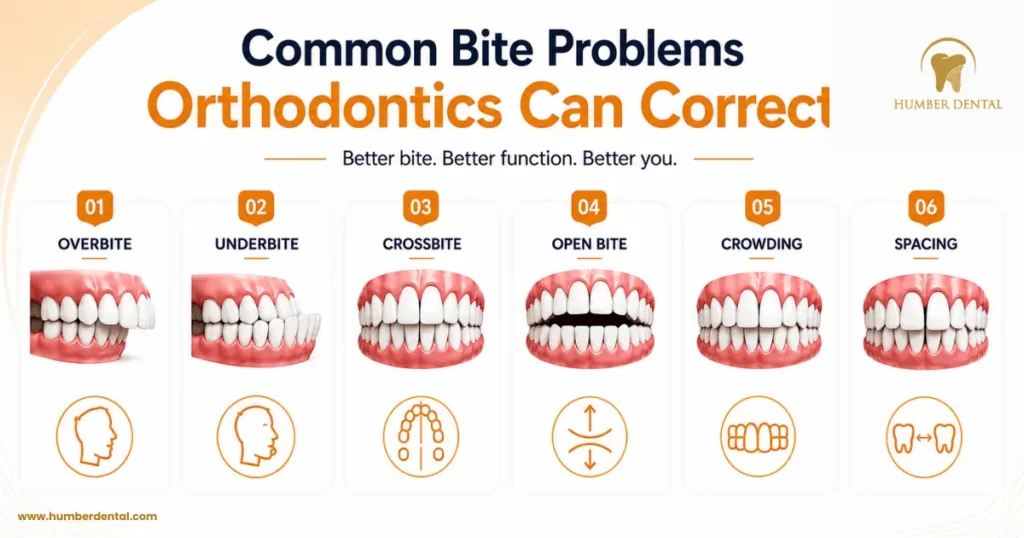
“Bite” describes how your upper and lower teeth come together. When they do not fit well, it is called a malocclusion, and bite correction treatment is one of the main goals of orthodontics. The most common types include:
1. Overbite
The upper front teeth overlap the lower front teeth too far. A deep overbite can contribute to tooth wear and jaw strain over time.
2. Underbite
The lower teeth sit ahead of the upper teeth, which can affect chewing and speech and often becomes more noticeable with age.
3. Crossbite
Some upper teeth close inside the lower teeth instead of outside them, which can lead to uneven wear and lopsided jaw development.
4. Open Bite
The front teeth do not touch when the back teeth are closed, which can make biting into food more difficult.
5. Crowding and Spacing
Either too little room (teeth overlap and twist) or too much (gaps appear). Both can make teeth harder to keep clean. Each of these usually responds well to modern orthodontics; read more in our detailed guide to bite problems
| 📋 Clinical Insight: Why an early check by about age 7 helps The Canadian Association of Orthodontists suggests children have a first orthodontic check-up by around age seven. It rarely means starting treatment that early; it simply lets the dentist monitor how the jaw and adult teeth are developing, so that if anything is needed, it can be timed for the greatest benefit. |
Your Orthodontic Treatment Options in Etobicoke
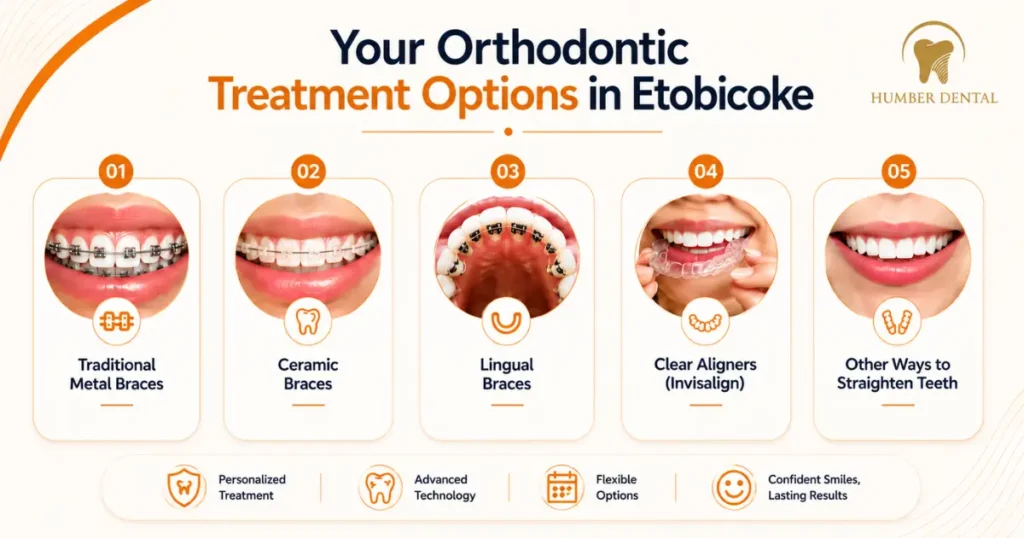
There has never been more choice when it comes to straightening teeth. The most suitable option depends on the complexity of your case, your lifestyle, and your budget, all of which an assessment with a dentist or orthodontist in Etobicoke clarifies quickly. Here are the main paths.
1. Traditional Metal Braces
The most established option, metal braces use brackets and wires to guide teeth into place. They are highly effective, especially for more complex cases. They work around the clock without any effort on your part, and are often the most economical form of braces treatment.
2. Ceramic Braces
These work like metal braces but use tooth-coloured or clear brackets that blend in, making them far less noticeable. They are a popular middle ground for patients who want fixed braces without the obvious metal look.
3. Lingual Braces
Lingual braces are fixed to the back of the teeth, so they are hidden from view. They offer the reliability of braces with very little visibility.
4. Clear Aligners (Invisalign)
Clear aligners treatment uses a series of custom, removable trays that are nearly invisible. You take them out to eat and brush, and switch to a new set every week or two. The trade-off is consistency: they only work if worn about 20 to 22 hours a day. To weigh this against fixed braces, see our comparison of braces versus clear aligners.
5. Other Ways to Straighten Teeth
For minor concerns, options such as dental bonding, veneers, or retainers may play a role. If you would rather avoid traditional braces altogether, explore the modern alternatives to metal braces.
Orthodontic Care for Every Age
Children: Early Care, Monitored Growth
An early orthodontic check does not necessarily mean early treatment. Often it simply lets the dentist watch how the jaw and adult teeth are developing. When a developing issue is caught early, any intervention can be timed for the greatest benefit, sometimes guiding growth in a way that reduces the need for more involved treatment later.
Teens: The Classic Window
The teenage years remain the most common time for braces or aligners, because most adult teeth have come in and the jaw is still adaptable. Today’s teens also have far more discreet choices than previous generations, which can make treatment easier to embrace.
Adults: It’s Rarely Too Late
Adults make up a steadily growing share of orthodontic patients, and for good reason: healthy teeth can be moved at most ages. Whether your teeth shifted over the years or you never had the chance to straighten them, discreet clear aligners and tooth-coloured braces let many adults improve their smile without it dominating work or social life.
| 📋 Clinical Insight: Adults are a large share of orthodontic patients Orthodontic associations report that roughly one in four orthodontic patients today is an adult. Treatment timelines may differ from a teenager’s because adult bone is no longer growing, but the goal of a healthier, better-aligned bite is very achievable. A consultation is the best way to set realistic expectations for your case. |
How Orthodontic Treatment Works, Step by Step
Every plan is personalized, but most orthodontic journeys follow the same broad path, and knowing it in advance removes much of the uncertainty.
1. Consultation and records. The dentist or orthodontist in Etobicoke examines your teeth and bite and usually takes a digital scan or X-rays, giving you both a clear picture of what is going on.
2. Your custom plan. Based on those records, you receive the option or options that fit your goals, along with the likely timeline and cost, with no pressure to decide on the spot.
3. Active treatment. Braces or aligners gently and gradually guide your teeth into place, with brief check-ins along the way to keep things on track.
4. Retention. Once your teeth are where they should be, a retainer holds them there: the final, essential step in protecting your result.
The Benefits of Orthodontic Treatment
1. Better Oral Health
Straight, well-spaced teeth are easier to brush and floss, which can mean fewer food traps and a lower risk of cavities and gum problems over the long term.
2. Improved Function
A well-aligned bite can make chewing more efficient and may ease speech issues caused by misaligned teeth, while reducing uneven wear so teeth last longer.
3. Less Jaw Strain
When the bite is balanced, the jaw is not constantly compensating for a poor fit. Many patients notice less tension and discomfort as a result.
4. Confidence
It is hard to overstate this one. People who feel good about their smile tend to smile more freely, in photos, at work, and in everyday life.
How Much Does Orthodontic Treatment Cost in Etobicoke?
Cost is usually the first practical question, and the honest answer is that it varies with your case. The figures below are general ranges for the Etobicoke area, not quotes, and your exact orthodontic treatment cost is confirmed only after an examination. For a fuller breakdown, see our guide to what orthodontic treatment really costs.
| Treatment | Typical Etobicoke range (CAD) | Notes |
|---|---|---|
| Traditional metal braces | $3,000 to $7,500 | Often the most economical full-treatment option |
| Ceramic braces | $4,000 to $8,000 | Tooth-coloured; less visible than metal |
| Clear aligners (Invisalign) | $4,000 to $8,500 | Varies with case complexity and number of trays |
| Early/interceptive (children) | $1,500 to $3,000 | Limited, growth-guiding treatment |
Several factors shape your final number: case complexity, the appliance you choose, how long treatment takes, and add-ons like scans and retainers. That is why two people can get quite different quotes. For option-specific figures, see our guides to braces pricing and Invisalign pricing, insurance and financing.
Insurance, Financing & CDCP Coverage
A treatment fee rarely comes out of one pocket all at once. Many private dental insurance plans cover a portion of orthodontic treatment, often up to a lifetime maximum, so it is always worth checking your specific policy booklet. On top of that, interest-free monthly payment plans can spread the balance into smaller, predictable amounts.
One question we hear constantly is whether the Canadian Dental Care Plan (CDCP) covers braces or Invisalign. As things stand, it does not: orthodontic services under the CDCP are listed as “to be determined,” and cosmetic adult aligners are not included. The CDCP does help eligible patients with many routine services such as exams, cleanings, and fillings. For the full picture, see our explainer, does CDCP cover orthodontic treatment .
Braces vs Clear Aligners: A Quick Comparison
| Braces | Clear Aligners (Invisalign) | |
|---|---|---|
| Visibility | Visible (less so with ceramic/lingual) | Nearly invisible |
| Removable | No (fixed in place) | Yes (removed to eat and clean) |
| Relies on willpower | No (works 24/7) | Yes (must wear 20 to 22 hrs/day) |
| Best suited to | Complex cases | Mild-to-moderate cases |
Your Orthodontic Action Plan
This Week
- Book an orthodontic consultation, the only way to get answers specific to your teeth.
- Note your main concern (crowding, a gap, bite trouble, or simply how your smile looks).
- Check your insurance booklet for orthodontic coverage and any lifetime maximum.
This Month
- Attend your assessment and digital scan, and review your realistic options and costs.
- Ask about interest-free payment plans and what your insurance would contribute.
- Choose the option that fits your case, lifestyle, and budget, with your dentist’s guidance.
Ongoing
- Follow your treatment and wear schedule, and keep up regular cleanings.
- Wear your retainer exactly as directed once active treatment ends.
Book an Orthodontic Consultation in Etobicoke
Whether you are weighing braces against Invisalign, curious about cost, or simply tired of hiding your smile, the best first step is a friendly consultation. We will look at your teeth together and map out the options that make sense for you, with no pressure.
📞 Call: (416) 745-4500
🌐 Online: humberdental.com
📍 Visit: 6100 Finch Ave W, Unit 205 & 206, Etobicoke, ON M9V 0A1
Evening and Saturday appointments available.
Frequently Asked Questions
Q1. At what age should my child first see an orthodontist?
Many orthodontic associations suggest a first check-up by around age seven. This usually isn’t about starting treatment early; it lets the dentist monitor jaw and tooth development so any treatment can be timed well.
Q2. Am I too old for braces or Invisalign?
Most adults are good candidates. Healthy teeth can be moved at most ages, and discreet options like clear aligners make treatment easy to fit into daily life. An assessment with a dentist or orthodontist in Etobicoke will confirm what’s realistic for your case.
Q3. Do braces or clear aligners hurt?
Most patients feel mild pressure or tenderness for a few days after braces are adjusted or a new aligner goes in, not constant pain. It usually settles quickly.
Q4. How long does orthodontic treatment take?
It depends on the case. Milder corrections can take under a year, while more complex treatment may run 18 to 36 months. Your dentist will give you a realistic estimate after an exam.
Q5. How much does orthodontic treatment cost in Etobicoke?
As a general guide for the area, braces typically range from about $3,000 to $7,500 and clear aligners from about $4,000 to $8,500. Your exact cost is confirmed at consultation and may be offset by insurance and payment plans.
Q6. Does the Canadian Dental Care Plan (CDCP) cover braces or Invisalign?
Not at this time. Orthodontic services under the CDCP are listed as “to be determined,” and cosmetic adult aligners are excluded. The CDCP does help eligible patients with many routine services. Private insurance and payment plans are usually the route for orthodontics.
Q7. Braces or Invisalign: which is better?
Neither is universally better. Braces handle complex cases and need no willpower; clear aligners are discreet and removable but must be worn faithfully. The right choice depends on your teeth, lifestyle, and budget.
Q8. Will treatment affect my speech?
Clear aligners may cause a slight lisp for a day or two as you adjust, which almost always fades quickly. Many patients find that correcting their bite improves speech over the long run.