| As of mid-2026, the Canadian Dental Care Plan (CDCP) does not cover orthodontic treatment such as braces or Invisalign. Orthodontic services are technically part of the plan but have not been implemented yet; the official guide states they can be requested at a date to be determined. When they do begin, coverage is expected to be limited to severe, medically necessary cases rather than general alignment or cosmetic treatment. The CDCP does, however, cover many routine dental services for eligible patients. |
If you are looking into braces or clear aligners, it is natural to ask whether the Canadian Dental Care Plan will help with the cost. This guide gives you a straight, plain-English answer on CDCP orthodontic coverage in 2026, who might qualify in future, and how to pay for treatment in the meantime. It accompanies our full overview of orthodontic care in Etobicoke. Because government programs can change, always confirm the current rules on Canada.ca before making decisions.
Does the CDCP Cover Braces or Invisalign Right Now?
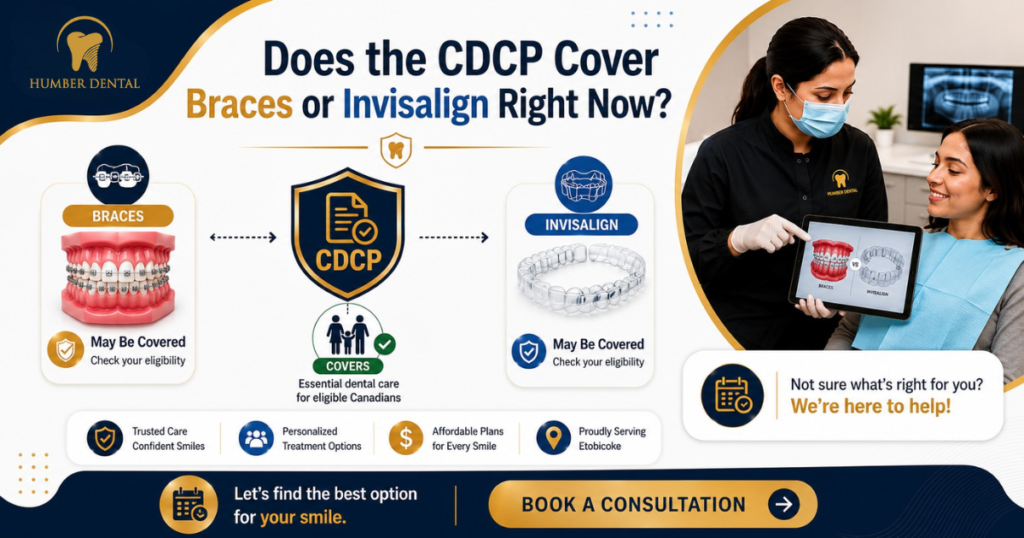
In short, no. As things stand in 2026, CDCP orthodontic treatment is not available. The plan technically includes a limited orthodontic benefit, but it has not been turned on. The CDCP Dental Benefits Guide describes these limited orthodontic services as something that
can be requested “at a date to be determined.” In practical terms, that means even the patients who may eventually qualify cannot access orthodontic coverage today, and there is no confirmed start date.
Who Might Be Covered When Orthodontics Begins
When the orthodontic benefit is eventually implemented, the criteria are expected to be narrow and based on medical necessity, not appearance:
- Children under 18: only those with a severe, functionally handicapping bite, assessed using a recognized clinical index.
- Adults 18 and over: only those with a craniofacial anomaly, such as cleft lip and palate, associated with a severe functional bite problem.
The takeaway is important: if you or your child needs braces or aligners for general crowding, spacing, or cosmetic reasons, the CDCP is not expected to help, even once the benefit is active. CDCP coverage is being reserved for rare, medically severe situations.
What the CDCP Does Cover
None of this means the CDCP lacks value. For eligible patients, it covers a wide range of routine and restorative care, which can free up your budget for orthodontic treatment paid another way. Commonly covered services include:
- Examinations, cleanings, fluoride, and sealants
- Fillings and many restorative treatments
- Tooth extractions and some minor oral surgery (some with preauthorization)
If you are eligible, it is well worth using the CDCP for your routine care with a CDCP dentist in Etobicoke, while handling orthodontics separately.
Who Qualifies for the CDCP?
Eligibility is based on four main requirements. To qualify, you generally must:
- Be a Canadian resident for tax purposes
- Have an adjusted family net income under $90,000
- Have no access to private dental insurance
- Have filed last year’s tax return (both partners, if applicable)
Coverage is then tiered by income: families under $70,000 currently have eligible services covered at the full CDCP rate, while those between $70,000 and $90,000 are covered at a reduced percentage. Even when a service is covered, you may pay a little extra if your provider’s fee is higher than the CDCP rate. The plan is administered by Sun Life, with eligibility determined by Service Canada, and applications for the 2026 to 2027 benefit year are open.
Paying for Orthodontic Treatment in Etobicoke Without CDCP
Since the CDCP will not cover routine orthodontics, most patients use two familiar routes. Many private dental insurance plans cover a portion of orthodontic treatment, often around half, up to a lifetime maximum. Interest-free monthly payment plans can then spread the rest into manageable amounts. For the full picture, see our guides to orthodontic treatment cost , braces cost and Invisalign cost.
Talk to an Orthodontist in Etobicoke
Not sure how coverage applies to your situation? Our team can help you check your private benefits and walk you through payment options. Book a consultation and we will give you a clear, honest picture before you commit to anything.
📞 Call: (416) 745-4500
🌐 Online: humberdental.com
📍 Visit: 6100 Finch Ave W, Unit 205 & 206, Etobicoke, ON M9V 0A1
Evening and Saturday appointments available.
Frequently Asked Questions
Q1. Does the CDCP cover braces?
Not at this time. Orthodontic services under the CDCP are listed as available at a date to be determined, so braces are not currently covered. When the benefit begins, it is expected to be limited to severe, medically necessary cases.
Q2. Does CDCP cover Invisalign?
No. Like braces, Invisalign is not currently covered, and cosmetic adult clear aligners are not expected to be included even when the limited orthodontic benefit is implemented.
Q3. Will the CDCP ever cover orthodontics?
A limited orthodontic benefit is written into the plan, but it has no confirmed start date and is expected to apply only to rare, medically severe cases. For most patients, it is safest to plan around private coverage.
Q4. Who qualifies for the CDCP?
In general, Canadian residents for tax purposes with an adjusted family net income under $90,000, no access to private dental insurance, and a filed tax return. Coverage is tiered by income.
Q5. What does the CDCP cover for dental?
For eligible patients, it covers many routine and restorative services, such as exams, cleanings, fluoride, sealants, fillings, and some extractions, with certain services needing preauthorization.
Q6. How do I pay for orthodontic treatment if CDCP does not cover it?
Most patients use a combination of private dental insurance and interest-free monthly payment plans. Our team can help you check your benefits and map out a plan that fits your budget.