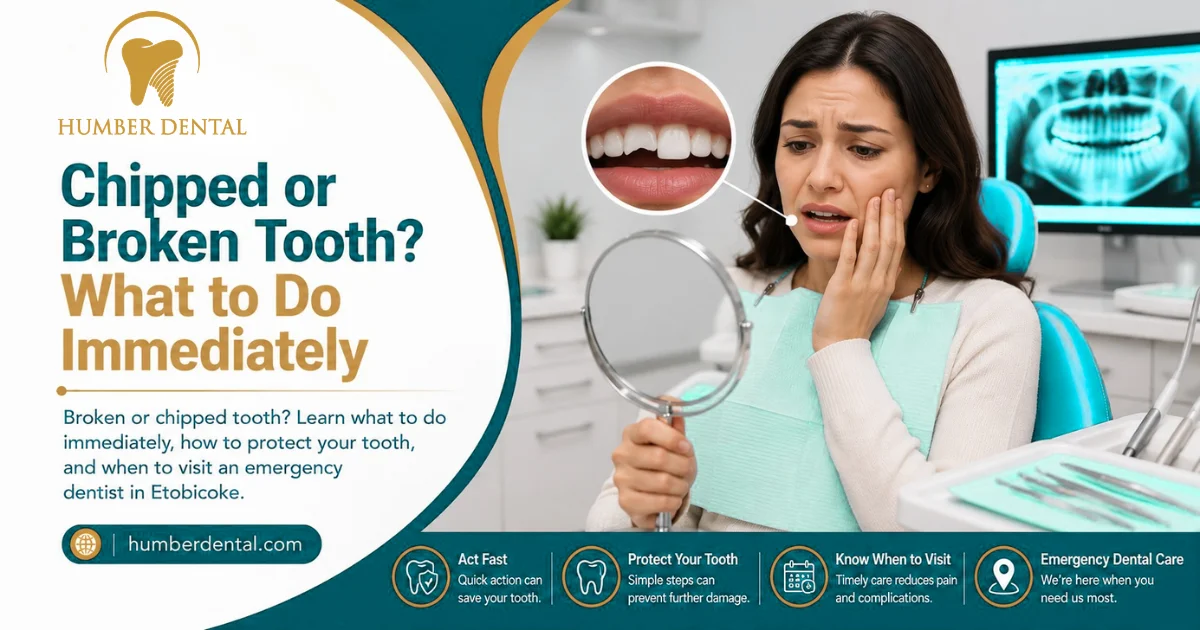
A broken tooth can happen faster than most people expect.
Sometimes it happens during sports. Sometimes, while eating something hard, or from an accidental fall, or suddenly biting down the wrong way.
In the moment, most people ask the same questions: “Is this serious?” “Can the tooth be saved?” “Do I need to go to the dentist right now?”
The good news is that many chipped or broken teeth can be successfully treated, especially when you act quickly.
Knowing what to do immediately can help reduce pain, protect the tooth, and prevent the damage from becoming worse.
Is a Chipped or Broken Tooth a Dental Emergency?
Not every chipped tooth is a major emergency, but some definitely require immediate treatment.
A small surface chip may only affect appearance. A deeper crack or fracture can expose the tooth’s inner nerve and lead to infection or severe pain.
You should seek urgent dental care if:
- Pain is severe
- Bleeding is present
- A large portion of the tooth broke off
- The tooth feels loose
- Swelling develops
- Sharp edges are cutting the mouth
The deeper the damage, the more important it is to receive prompt treatment.
What To Do Immediately After Breaking a Tooth
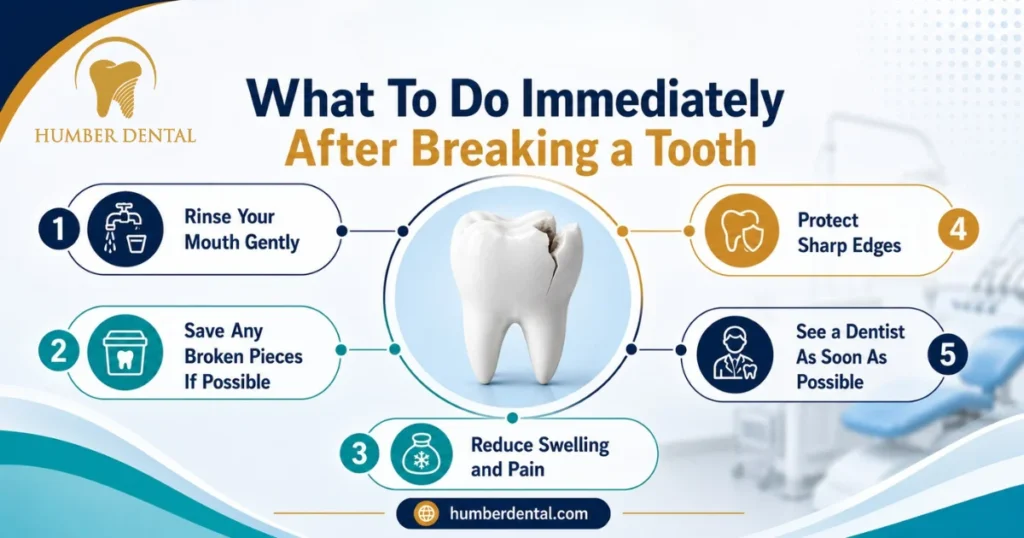
The first few steps matter more than many people realize.
1. Rinse Your Mouth Gently
Use warm water to rinse away blood, debris, or broken fragments.
This helps:
- Keep the area cleaner
- Reduce irritation
- Make it easier to see the damage
Avoid aggressively brushing or touching the broken area.
2. Save Any Broken Pieces If Possible
If part of the tooth broke off, try to keep the pieces safely.
In some situations, the dentist may be able to use the fragment during chipped tooth repair or restoration treatment.
Store broken pieces in:
- Milk
- Saliva
- A clean container
3. Reduce Swelling and Pain
A cold compress placed outside the cheek can help reduce swelling and discomfort temporarily.
For safer pain management:
- Avoid chewing on the damaged side
- Stick to softer foods
- Use over-the-counter pain relief if appropriate
These steps may help temporarily, but they do not replace professional dental care.
4. Protect Sharp Edges
Broken teeth sometimes leave sharp edges that irritate the tongue or cheek.
Dental wax or sugar-free gum may help temporarily cover rough areas until you can receive immediate dental care in Etobicoke.
5. See a Dentist As Soon As Possible
Even if the pain feels manageable initially, cracks and fractures can worsen quickly.
A dentist can determine:
- How deep the damage goes
- Whether the nerve is affected
- What type of restoration is needed
The sooner treatment begins, the better the chances of protecting the natural tooth.
What Causes a Broken Tooth?
A broken tooth is often caused by:
- Biting hard foods or ice
- Sports injuries
- Falls or accidents
- Untreated tooth decay
- Teeth grinding or clenching
In many cases, teeth with large fillings or untreated cavities are more vulnerable to fractures.
Can a Dentist Fix a Broken or Chipped Tooth?
Yes, most chipped or broken teeth can be successfully repaired.
The type of dental emergency treatment depends on the severity of the damage.
Common treatments include:
- Dental bonding for small chips
- Crowns for larger fractures
- Root canal treatment if the nerve is exposed
- Tooth extraction in severe cases
The goal is always to save the natural tooth whenever possible.
What Happens During the Emergency Dental Visit?
An emergency dentist for broken tooth injuries will first examine the tooth carefully.
This may include:
- Visual examination
- Digital X-rays
- Bite evaluation
- Sensitivity testing
The dentist will then recommend treatment based on:
- Crack depth
- Tooth stability
- Nerve involvement
- Infection risk
In many situations, temporary treatment may be done immediately to stabilize the tooth and reduce discomfort.
Can a Small Chipped Tooth Become Worse?
Yes, even small chips can become larger if left untreated.
A chipped area weakens the tooth structure and may:
- Crack further
- Become sensitive
- Collect bacteria
- Lead to infection later
This is why early treatment for a chipped tooth is usually recommended, even when pain is minimal.
When You Should Not Wait
You should seek immediate emergency dental care if:
- Pain becomes severe
- Swelling develops
- The tooth changes color
- The tooth becomes loose
- Sensitivity increases rapidly
These signs may indicate deeper internal damage or infection.
How To Help Prevent Broken Teeth
Some dental injuries are unavoidable, but many can be reduced with preventive care.
Helpful habits include:
- Avoid chewing hard objects or ice
- Wear sports mouth guards during contact sports
- Treat cavities early
- Use night guards if you grind your teeth
Regular dental checkups also help identify weak or damaged teeth before fractures happen.
Don’t Get Stressed – Act Smart When Dealing with a Chipped or Broken Tooth

A broken tooth may feel stressful in the moment, but fast action can make treatment much easier and more successful.
The key is to:
- Protect the tooth
- Avoid delaying treatment
- Get professional evaluation quickly
At Humber Dental, we provide same-day emergency appointments for chipped, cracked, and broken teeth to help patients get relief and protect their smiles as early as possible.
FAQs – Chipped or Broken Tooth
Q1. What should I do immediately after breaking a tooth?
You should rinse your mouth gently, save broken pieces if possible, reduce swelling with a cold compress, and seek emergency dental care quickly.
Q2. Can a chipped tooth be repaired?
Yes, chipped tooth repair is commonly done using bonding, crowns, or other restorative dental treatments, depending on the severity of the damage.
Q3. Is a broken tooth always a dental emergency?
A broken tooth becomes an emergency if there is severe pain, swelling, bleeding, or exposed nerve involvement requiring urgent dental care.
Q4. Can an emergency dentist fix a broken tooth the same day?
Yes, an emergency dentist for broken tooth injuries can often provide same-day treatment to stabilize or repair the damaged tooth.
Q5. What happens if I ignore a chipped tooth?
Ignoring a chipped tooth may lead to worsening cracks, sensitivity, infection, or more complex dental treatment later.