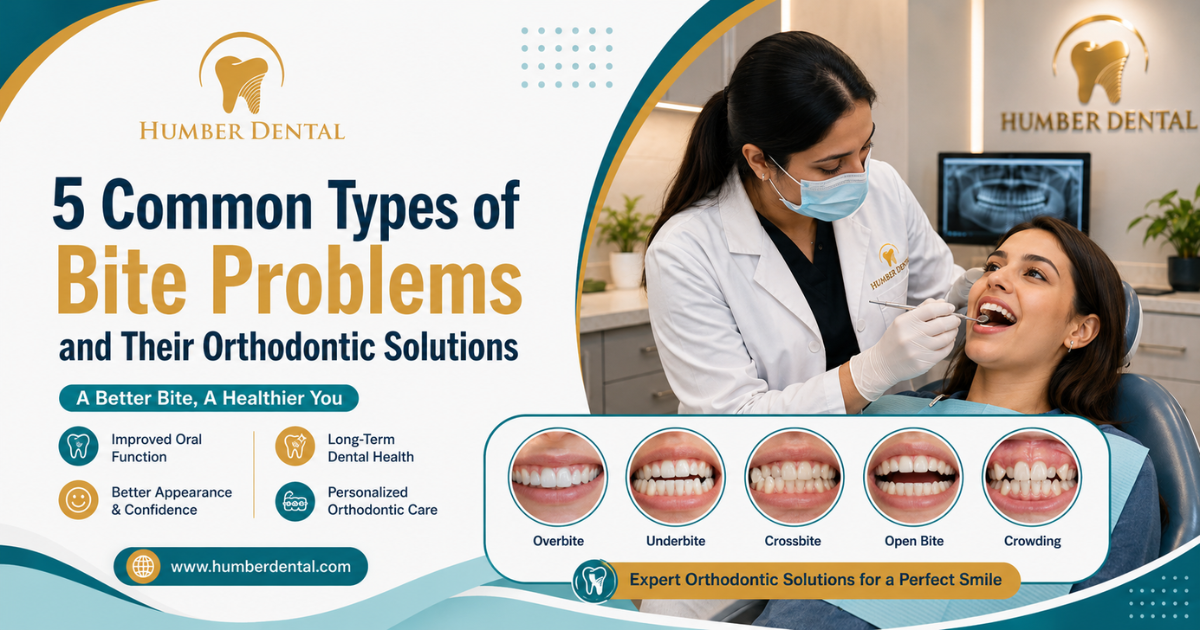
| The five most common bite problems are overbite, underbite, crossbite, open bite, and crowding or spacing. Each describes a different way the upper and lower teeth fail to meet correctly, and each can usually be corrected with orthodontic treatment such as braces or clear aligners. Left unaddressed, bite problems may lead to uneven tooth wear, jaw strain, and teeth that are harder to keep clean. An assessment at an orthodontic clinic in Etobicoke can confirm which type you have and the most suitable solution. |
Your “bite” is simply how your upper and lower teeth come together. When they do not line up well, dentists call it a malocclusion. The good news is that the common bite problems described here are well understood and, in most cases, very treatable. This guide is part of our wider overview of orthodontic care in Etobicoke, and it explains each type, why it matters, and how it is corrected.
The 5 Most Common Bite Problems
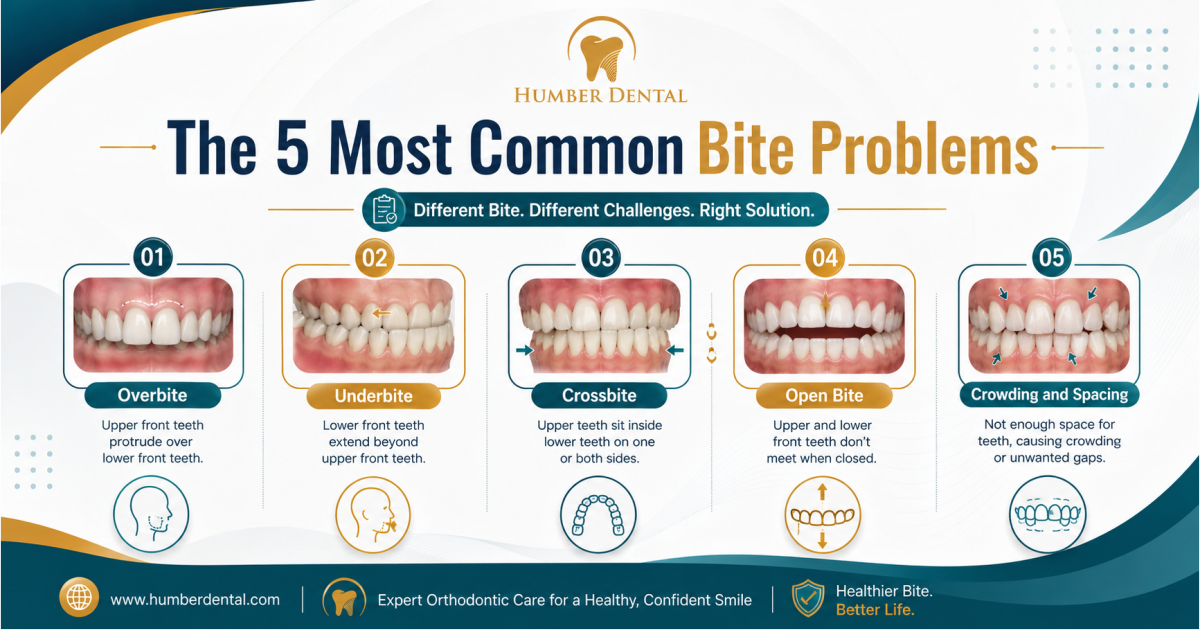
Here are the five types of bite problems we see most often, at a glance:
| Bite problem | What it looks like | Typical orthodontic solution |
|---|---|---|
| Overbite | Upper front teeth overlap the lowers too far | Braces or clear aligners; growth guidance in children |
| Underbite | Lower teeth sit ahead of the upper teeth | Braces or aligners; early or combined care for severe cases |
| Crossbite | Some upper teeth close inside the lowers | Braces or aligners; a palatal expander in children |
| Open bite | Front teeth do not touch when biting down | Braces or aligners; addressing habits such as thumb-sucking |
| Crowding/spacing | Too little or too much room between teeth | Braces or aligners; occasionally tooth removal for severe crowding |
1. Overbite
With an overbite, the upper front teeth overlap the lower front teeth more than they should. A small overlap is normal; a deep one can wear down the lower teeth and contribute to jaw strain over time. Braces or clear aligners can usually reposition the teeth, and in growing children, a dentist may use growth-guiding approaches to help.
2. Underbite
An underbite is the reverse: the lower teeth sit ahead of the upper teeth. It can affect chewing and speech and often becomes more noticeable with age. Many cases respond well to braces or aligners, while more significant, jaw-related cases may benefit from earlier intervention or, occasionally, combined treatment.
3. Crossbite
In a crossbite, some upper teeth close inside the lower teeth rather than outside them. This can cause uneven wear and, in children, lopsided jaw growth. Braces or aligners can correct the tooth position, and a palatal expander is sometimes used in younger patients to widen a narrow upper arch.
4. Open Bite
An open bite means the front teeth do not touch when the back teeth are closed, which can make biting into food awkward. Treatment focuses on closing the gap with braces or aligners, and on addressing any underlying habits, such as prolonged thumb-sucking or tongue thrusting, that contributed to it.
5. Crowding and Spacing
Crowding happens when there is too little room and teeth overlap or twist; spacing is the opposite, with visible gaps. Both can make teeth harder to keep clean. Most cases are corrected with braces or clear aligners, and severe crowding occasionally calls for removing a tooth to create room. To weigh the main appliance choices, see our comparison of braces versus clear aligners.
Why Bite Problems Are Worth Addressing
Bite problems are not only about appearance. When teeth do not meet evenly, the forces of chewing are spread unevenly too, which can lead to uneven wear, chips, and added strain on the jaw. Crowded or gapped teeth are also harder to clean, which can raise the risk of cavities and gum problems over time.
This is why even a bite that looks fine can be worth checking. Jaw alignment issues in particular, such as clicking, tension, or difficulty chewing, are easier to manage when they are identified early.
How Bite Problems Are Treated
Most bite problems are corrected with teeth alignment treatment using braces or clear aligners, sometimes alongside supportive appliances like expanders in children. The right plan depends on the type and severity of the problem, your age, and your goals, and it is mapped out after an examination. For a sense of timelines and what to expect, our pillar guide to orthodontic care walks through the full process.
Get Your Bite Checked in Etobicoke
If any of these sound familiar, a quick assessment is the best next step. Book a bite assessment and we will examine how your teeth meet, explain what we find in plain language, and lay out your options.
📞 Call: (416) 745-4500
🌐 Online: humberdental.com
📍 Visit: 6100 Finch Ave W, Unit 205 & 206, Etobicoke, ON M9V 0A1
Evening and Saturday appointments available.
Frequently Asked Questions
Q1. What are the most common bite problems?
The five most common are overbite, underbite, crossbite, open bite, and crowding or spacing. Each describes a different way the upper and lower teeth do not meet correctly.
Q2. Can bite problems be fixed with Invisalign?
Many mild to moderate bite problems can be treated with clear aligners. More complex cases may be better suited to braces. An assessment will confirm what works for your case.
Q3. Do bite problems cause jaw pain?
They can. An uneven bite may contribute to jaw strain, clicking, or discomfort for some people, though not everyone notices symptoms. A dentist can help identify whether your bite is a factor.
Q4. At what age should bite problems be treated?
Many associations suggest a first orthodontic check by around age seven, which helps catch developing issues early. That said, bite problems can be treated at most ages, including adulthood.
Q5. What happens if a bite problem is left untreated?
It may stay stable, or it may contribute to uneven tooth wear, harder-to-clean teeth, and jaw strain over time. A check-up is the best way to understand your specific risk.
Q6. How do I know which bite problem I have?
Only an in-person examination can confirm the type and severity. If you have noticed crowding, gaps, or teeth that do not meet well, an assessment at an orthodontic clinic in Etobicoke will give you a clear answer.