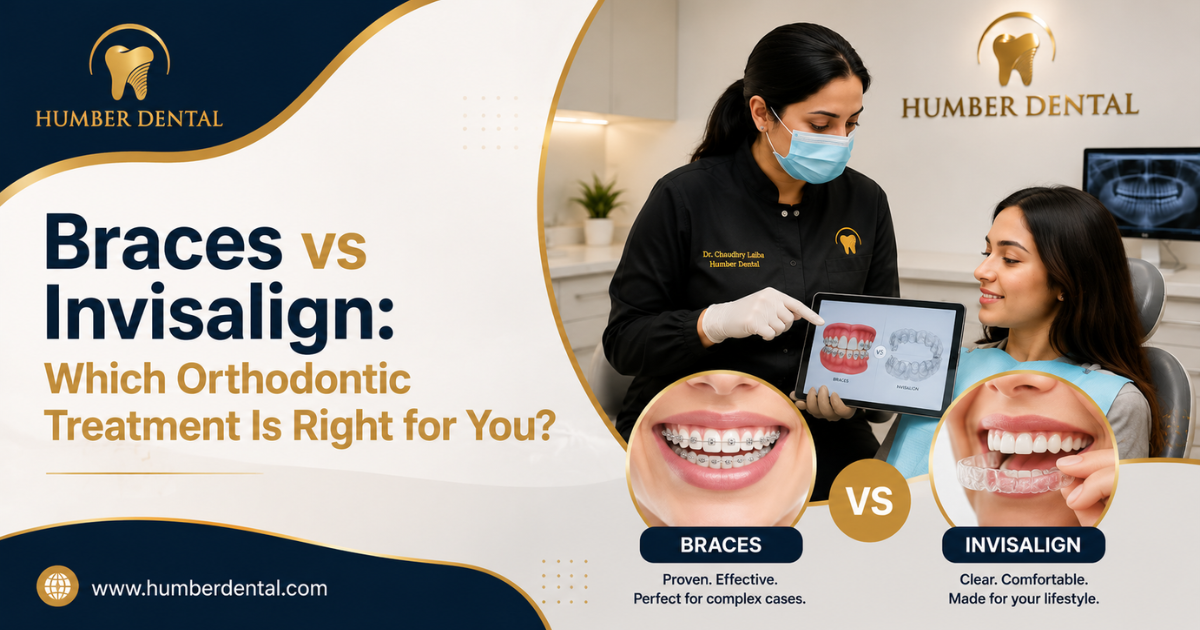
| Neither option is universally better. Traditional braces are the stronger choice for complex cases and need no willpower, since they work around the clock; clear aligners such as Invisalign are nearly invisible and removable, but only work if you wear them about 20 to 22 hours a day. The two overlap in price, so the right pick comes down to your case, your lifestyle, and your discipline. The best way to decide is an assessment with a dentist or orthodontist in Etobicoke. |
“Braces or Invisalign?” is one of the most common questions we hear, and there is no one-size-fits-all answer. Both can give you a straighter smile; they simply get there in different ways. This guide, part of our wider overview of orthodontic care in Etobicoke , compares the two side by side and walks through how to choose.
Braces vs Invisalign: Side by Side
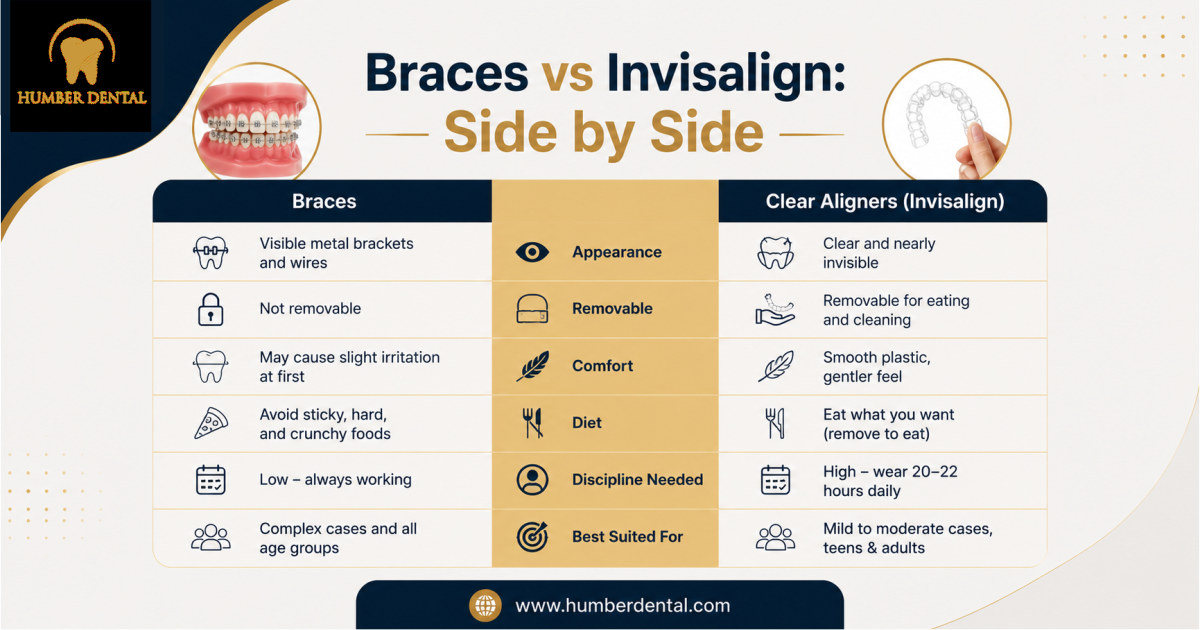
| Feature | Traditional Braces | Clear Aligners (Invisalign) |
|---|---|---|
| Appearance | Visible (less so with ceramic) | Nearly invisible |
| Removable | No (fixed in place) | Yes (removed to eat and clean) |
| Comfort | May rub cheeks and lips at first | Smooth trays, comfortable for many |
| Diet | Avoid hard and sticky foods | No restrictions (removed to eat) |
| Relies on willpower | No (works 24/7) | Yes (must wear 20 to 22 hrs/day) |
| Best suited to | Complex cases | Mild to moderate cases |
Traditional Braces: Strengths and Trade-offs
Traditional braces use brackets bonded to the teeth and a wire that is adjusted over time to guide them into place. Metal is the classic version, while tooth-coloured ceramic braces offer a more discreet look.
Their biggest strengths are reliability and consistency. Braces can handle complex movements that aligners may struggle with, and because they are fixed in place they work continuously, with no reliance on you to remember anything. They are also often the most economical form of treatment.
The trade-offs are familiar: they are more visible, you will want to avoid hard and sticky foods, cleaning around brackets takes a little more care, and an occasional wire adjustment may be needed. For most patients these are minor and short-lived.
Clear Aligners (Invisalign): Strengths and Trade-offs
Clear aligners are a series of custom, removable trays you switch every week or two. Each set moves your teeth a little closer to the goal.
Their appeal is obvious: they are nearly invisible, you remove them to eat and to brush, and many people find the smooth trays comfortable. There are no food restrictions, because the trays simply come out at mealtimes.
The main trade-off is discipline. Clear aligners only work if worn about 20 to 22 hours a day, so they suit people who can keep that routine. They are also better suited to mild and moderate cases. If you would rather avoid braces but are not sure aligners are right, it is worth exploring the full range of ways to straighten teeth without braces.
Which Is Right for You?
The best teeth straightening options are simply the ones that match your situation. A few questions usually point the way:
- How complex is your case? More complex bites often favour braces.
- How disciplined are you? Aligners only work if you wear them consistently.
- How important is discretion? Clear aligners or ceramic braces suit those who want a subtler look.
- What is your routine? Frequent snacking or sports can make removable aligners harder to keep up with.
None of these has to be answered alone. An assessment with a dentist or orthodontist in Etobicoke matches the method to your teeth and your day-to-day life.
Is One Cheaper Than the Other?
Cost is rarely the deciding factor, because braces and clear aligners overlap heavily in price; the bigger driver is the complexity of your case rather than the method itself. For the numbers, see our guides to orthodontic treatment cost , braces cost , and Invisalign cost.
Decide With Confidence in Etobicoke

Still on the fence? That is exactly what a consultation is for. Book an assessment and we will show you which option fits your teeth, your lifestyle, and your budget, with no pressure either way.
📞 Call: (416) 745-4500
🌐 Online: humberdental.com
📍 Visit: 6100 Finch Ave W, Unit 205 & 206, Etobicoke, ON M9V 0A1
Evening and Saturday appointments available.
Frequently Asked Questions
Q1. Is Invisalign as effective as braces?
For many mild to moderate cases, clear aligners work very well. For complex movements, braces may still be the more reliable choice. An assessment will tell you which suits your case.
Q2. Are braces or Invisalign more expensive?
They overlap heavily in price. The bigger factor is the complexity of your case rather than the method itself.
Q3. Do braces work faster than Invisalign?
It depends on the case more than the method. Both can be efficient, and your treatment time is estimated after an exam.
Q4. Can I switch from Invisalign to braces, or the other way around?
Sometimes, yes. If aligners are not progressing as planned, your dentist may suggest adjusting the approach. This is decided case by case.
Q5. Which is better for adults?
Both work well for adults. Many adults prefer clear aligners for discretion, but braces remain a strong option, especially for more complex cases.
Q6. Are clear aligners hard to keep up with?
They do require discipline, about 20 to 22 hours of wear a day. If you expect to struggle with that, fixed braces may be the easier path.