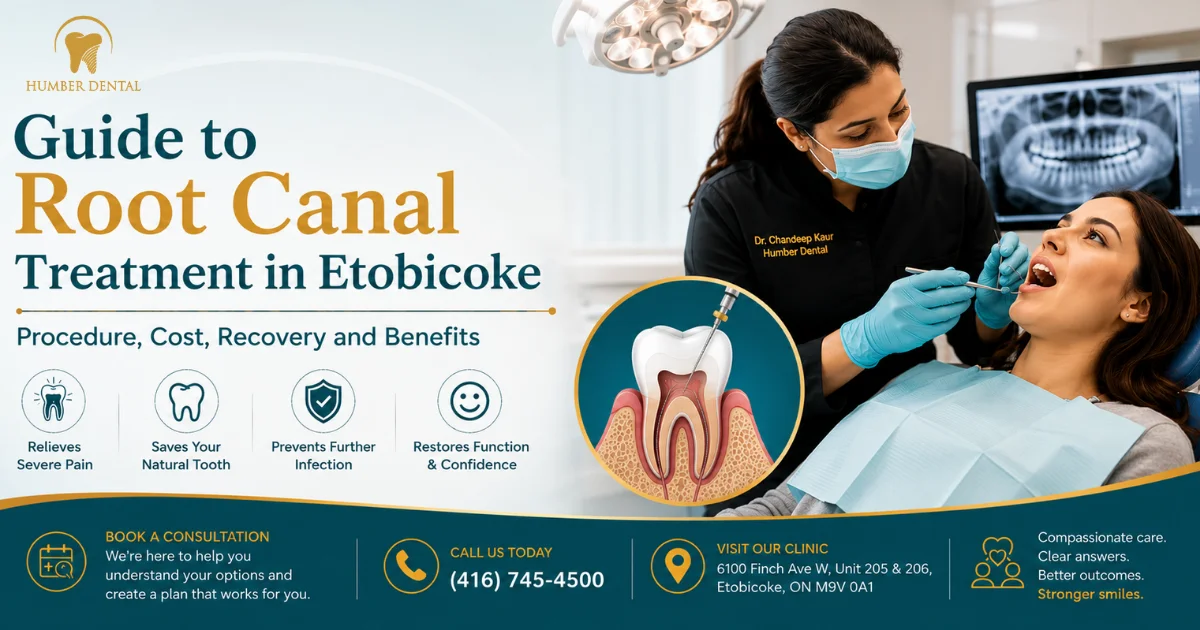
For most people, the fear of root canal comes from stories, not experience, and the reality of modern root canal treatment is closer to having a filling than the ordeal people imagine. It is one of the most common and most successful ways to save a tooth that would otherwise be lost.
This guide pulls the whole topic together in one place: what root canal treatment actually is, the signs you might need one, exactly how the procedure works, what it costs in Etobicoke and how coverage helps, what recovery looks like, and how it compares to pulling the tooth. Wherever a topic deserves a deeper look, we link to a focused article so you can follow the thread that matters to you.
Root canal treatment is a procedure that removes infected or inflamed tissue from inside a tooth, cleans and seals the space, and saves the natural tooth. It is done under local anaesthetic, so it is usually no more uncomfortable than a filling, and it has a high success rate. At Humber Dental in Etobicoke, root canal therapy is often completed in one or two visits, with a crown added afterward to protect the tooth.
Call (416) 745-4500 to book an assessment.
What Is a Root Canal, Really?
Every tooth has a soft core called the pulp, which contains nerves and blood vessels. When deep decay, a crack or repeated dental work lets bacteria reach the pulp, it becomes inflamed or infected, and that is what causes the throbbing pain people associate with needing a root canal. Left alone, the infe,ction can spread and the tooth can be lost.
Root canal treatment, also called endodontic treatment, removes that damaged pulp, cleans and disinfects the narrow canals inside the roots, and seals them so bacteria cannot return. The tooth stays in place; only the infected inside is removed. Think of it as saving the tooth by clearing out what has gone wrong inside it.
This is why root canal therapy matters so much: it lets you keep your own natural tooth, roots and all, rather than removing it and dealing with a gap. A tooth that has had a root canal and a crown can last for many years, often for life.
Signs You Might Need a Root Canal
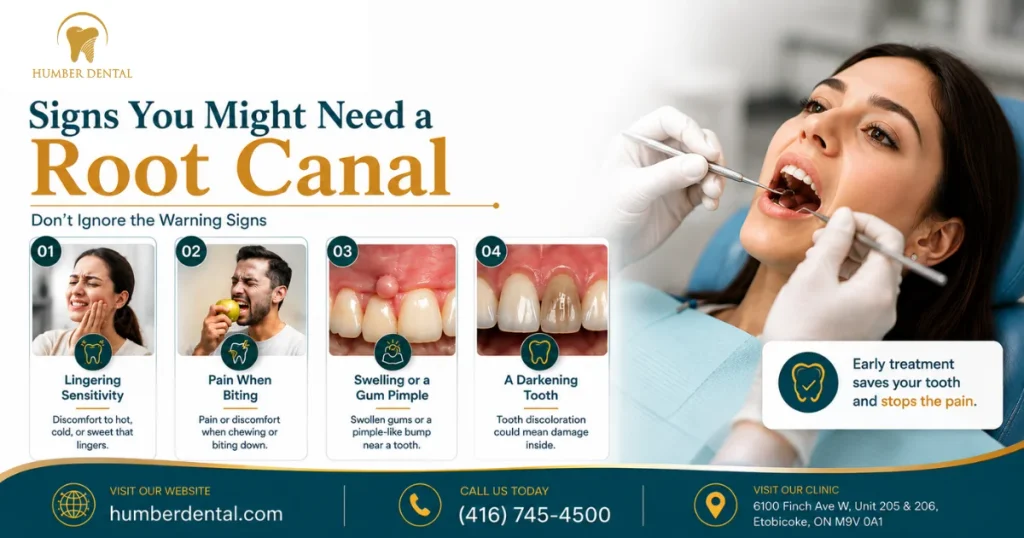
Some root canal problems announce themselves loudly; others are quiet until they are advanced. The tooth does not always hurt, which is why regular checkups matter, but there are common warning signs worth knowing.
- Lingering Sensitivity: Pain from hot or cold that lasts well after the food or drink is gone, rather than a quick flicker.
- Pain When Biting: A tooth that hurts when you chew or press on it, which can signal inflammation at the root.
- Swelling or a Gum Pimple: Swelling around a tooth, or a small recurring bump on the guan m, can point to infection draining.
- A Darkening Tooth: A single tooth that turns grey or dark can mean the pulp inside has died.
Read more: 10 warning signs you may need a root canal
Does a Root Canal Hurt?
This is the question almost everyone asks, and the short answer is no, not the way people fear. A root canal is performed under local anaesthetic, so the tooth and the area around it are fully numb, and most patients say the treatment itself feels much like getting a filling.
Here is the part that surprises people: the pain associated with root canals is almost always the pain of the infection beforehand, not the treatment. The procedure is what relieves that pain. Afterward the tooth may feel tender for a few days, which settles with ordinary pain relief.
Read more: Does a root canal hurt
The Root Canal Procedure, Step by Step
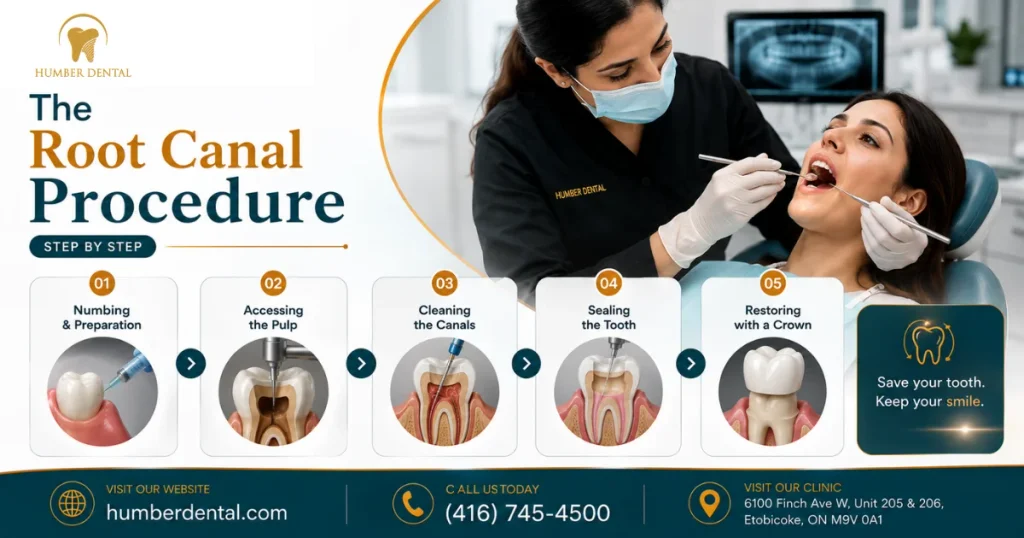
Knowing what happens takes a lot of the worry out of it. A typical root canal procedure follows the same clear steps.
- Numbing and Preparation: The area is fully numbed, and a thin protective sheet keeps the tooth clean and dry during treatment.
- Accessing the Pulp: A small opening is made in the top of the tooth to reach the inflamed or infected pulp.
- Cleaning the Canals: The damaged pulp is removed, and the narrow canals inside the roots are cleaned, shaped and disinfected.
- Sealing the Tooth: The cleaned canals are filled with a rubber-like material and sealed so bacteria cannot return.
- Restoring with a Crown: The tooth is closed with a filling and, for most back teeth, protected with a crown to restore full strength.
Types of Root Canal Treatment
Not every case is the same, and the term covers a few related procedures. Knowing the types of root canal treatment helps you understand your own plan.
- Primary Root Canal: The standard first-time treatment of an infected or inflamed tooth, which is what most people have.
- Root Canal Retreatment: Occasionally a previously treated tooth becomes reinfected and needs to be reopened, cleaned again and resealed.
- Front Tooth vs Molar: Front teeth usually have a single canal and are simpler, while molars have several canals and take a little longer.
Root Canal Recovery: What to Expect
Recovery from a root canal is usually mild and short. For the ,first day or two the tooth and jaw may feel tender, especially when biting, and over-the-counter pain relief is generally all that is needed. Most people return to work or school the same day or the next.
It helps to avoid chewing on the treated side until any final crown is placed, since the tooth is more vulnerable until it is fully restored. Full healing of the tissues around the root continues quietly over the following weeks.
Read more: the root canal recovery timeline
How Much Does a Root Canal Cost in Etobicoke?
There is no single price for a root canal, because the cost depends on the tooth and the treatment it needs. A front tooth with one canal is more straightforward than a molar with several, and most back teeth also need a crown afterward, which is a separate part of the cost. Ontario dentists reference the annual Ontario Dental Association Suggested Fee Guide, and your exact fee is set out in writing before treatment begins.
The good news is that root canal treatment is widely covered. Most dental insurance plans include endodontic treatment, and the Canadian Dental Care Plan may cover eligible services for eligible patients. Humber Dental bills most insurance directly and offers financing, so cost is never a reason to lose a tooth. We give you an itemised estimate upfront, with no surprises.
Read more: how much a root canal costs in Etobicoke
Does CDCP Cover Root Canal Treatment?
The Canadian Dental Care Plan, or CDCP, helps eligible residents without private coverage afford dental care, and it may cover eligible services including some endodontic treatment for eligible patients. Whether a specific root canal is covered depends on your eligibility and the services the plan covers, and some treatments may require preauthorization.
Humber Dental welcomes CDCP patients for eligible services. If you are unsure whether you qualify or what is covered, we can help you understand your options before treatment.
Read more: Does CDCP cover root canal treatment
Root Canal vs Tooth Extraction
When a tooth is badly infected, you generally have two choices: save it with a root canal, or remove it. Pulling the tooth can seem simpler and cheaper at first, but a missing tooth creates its own problems. Neighbouring teeth drift, the bite changes, and the jawbone shrinks, and replacing the tooth with an implant or bridge often costs more in the long run than saving it would have.
For most teeth that can be saved, keeping your natural tooth with a root canal is the better long-term choice for your bite, your bone and your budget. Extraction is the right answer when a tooth is too damaged to save, and we will always tell you straight which situation you are in.
Read more: Root canal vs tooth extraction
What Happens If You Delay a Root Canal?
A tooth that needs a root canal will not heal on its own, because the infection inside cannot clear without treatment. Waiting tends to make things worse, not better. The infection can spread, an abscess can form, and the bone around the root can be damaged, which can turn a savable tooth into one that must be remove,d.
In some cases a spreading dental infection becomes a medical emergency, with facial swelling and fever that need prompt care. Acting early keeps the treatment simpler, cheaper and more likely to save the tooth.
Read more: What happens if you delay a root canal
The Benefits of Root Canal Treatment
When people weigh it up, the benefits of root canal treatment are clear.
- You Keep Your Natural Tooth: Nothing works quite like your own tooth for biting, chewing and appearance.
- It Relieves Pain: The procedure clears the infection that causes the pain, rather than masking it.
- It Protects Your Other Teeth: Saving the tooth keeps your bite stable and stops neighboring teeth from drifting.
- It Is a Lasting Fix: A treated and crowned tooth can last many years, often for the rest of your life.
Why Choose Humber Dental for Root Canal Treatment in Etobicoke
As a root canal dentist in Etobicoke, Humber Dental combines experience with modern technology to make treatment comfortable and effective. Care is led by Dr. Rabin, DDS, a University of Toronto graduate who has practised in Etobicoke since the 1970s, alongside an experienced team, and the clinic uses 3D imaging, modern techniques and sedation options for anxious patients.
We are on Finch Avenue W at Finch and Albion, with free parking, evening and Saturday appointments, and same-day spots for dental pain. More than 450 patients have rated the experience five stars, and we welcome CDCP and IFHP patients for eligible services. If a tooth is hurting, we can usually see you quickly.
Save Your Tooth with Root Canal Treatment in Etobicoke

If a tooth is aching, sensitive or swollen, the sooner it is assessed the more likely it can be saved. Humber Dental offers gentle root canal treatment in Etobicoke, with same-day spots for pain, evening and Saturday hours, and clear pricing. Book online, or call or walk in.
Humber Dental | 6100 Finch Avenue W, Unit 205 & 206, Etobicoke, ON M9V 0A1
At Finch & Albion, in the Albion Finch Plaza. Free on-site parking. Call or Walk In: (416) 745-4500 | Book Online: HumberDental.com
FAQs About Root Canal Treatment
Q1. Is a root canal painful?
No, not the way people fear. A root canal is done under local anaesthetic, so the tooth is fully numb and the treatment feels much like a filling. The pain people associate with root canals is usually the infection beforehand, which the procedure relieves. Call (416) 745-4500 to book.
Q2. How long does a root canal take?
Many root canals are completed in one or two visits, depending on the tooth and how many canals it has. A front tooth is quicker than a molar. Your dentist will give you a clear timeline after assessing the tooth. Book an assessment to find out what yours involves.
Q3. Do I need a crown after a root canal?
Usually yes, especially on back teeth. A crown protects the treated tooth, which can become brittle, and restores full chewing strength. Some front teeth may be restored with a filling instead. We will explain what your tooth needs and what it costs upfront.
Q4. How much does a root canal cost in Etobicoke?
The cost depends on the tooth, the number of canals and whether a crown is needed, so we provide an itemised written estimate before treatment. We bill most insurance directly and welcome CDCP for eligible services. Call (416) 745-4500 for a clear estimate.
Q5. How successful are root canals?
Root canal treatment has a high success rate, and a properly treated and crowned tooth can last many years, often for life. Success depends on the tooth and on restoring it promptly with a crown. Bo,ok an assessment and we will explain the outlook for your tooth.
Q6. What happens if I don’t get a root canal?
The infection will not clear on its own and tends to spread, which can lead to an abscess, bone damage and loss of the tooth, and sometimes a medical emergency. Treating it early is simpler and more likely to save the tooth. Call (416) 745-4500 if a tooth is painful.