
| No. Under the official CDCP rules, dental implants and all implant-related procedures, including implant-supported dentures and implant crowns, are excluded and not covered. The plan does help with other missing-teeth care, though: exams, extractions, and removable dentures for eligible patients. So while CDCP for dental implants won’t apply, it can offset the care around them, and private insurance, the medical expense tax credit, and interest-free payment plans can help with the implants themselves. |
If you’re pricing implants and hoping the Canadian Dental Care Plan will help, it’s a completely reasonable thing to check. Let’s give you a straight, accurate answer, and, because it isn’t the one most people hope for, let’s also cover what you can do about it.
A quick note before we start: government programs change, so always confirm the current rules on Canada.ca before making a decision. What follows reflects the plan as it stands in 2026.
Does CDCP Cover Dental Implants?
In short, no. When people ask does cdcp cover dental implants, the official answer is clear. The CDCP Dental Benefits Guide lists dental implants, implant crowns, and implant-supported dentures as exclusions that are “not covered under the CDCP.” The plan treats implants as a specialized, elective procedure rather than basic care, because missing teeth can be treated with covered options like dentures.
| 🩺 Clinical Note: What “excluded” actually means here This isn’t a grey area you can appeal. The official guide states that implant-related procedures are exclusions and are not even eligible for reconsideration. So there’s no preauthorization path that turns a standard implant into a covered service. For any implant you’re planning now, it’s safest to assume the CDCP will not contribute toward the implant itself. |
What the CDCP Does Cover for Missing Teeth
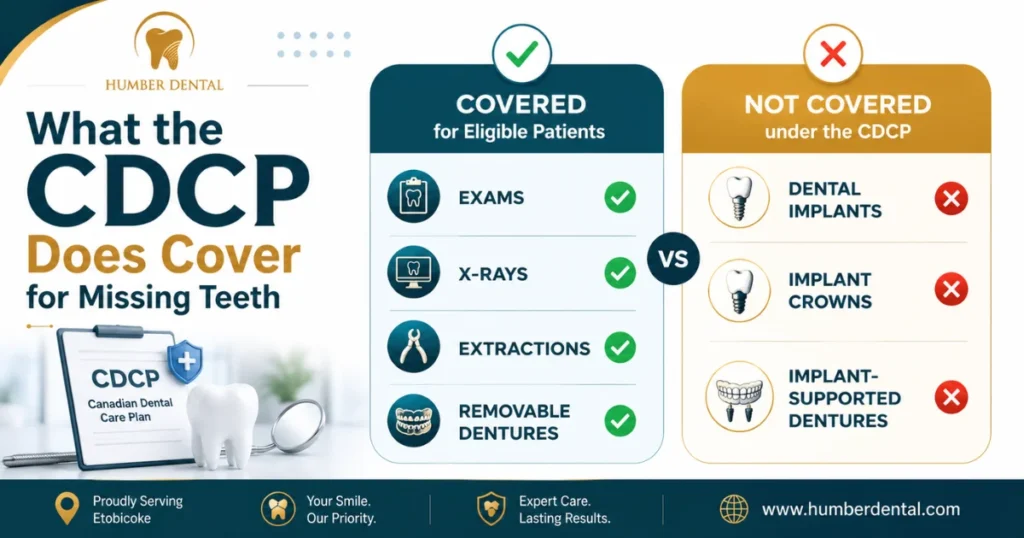
Here’s the reassuring part, and it’s genuinely useful. Even though implants are out, the cdcp missing teeth coverage around them is real. For eligible patients, the plan helps with the care that often surrounds tooth replacement, and it covers removable dentures as the funded way to replace missing teeth.
| Covered for eligible patients | Not covered (implant-related) |
|---|---|
| Exams, X-rays, and cleanings | Dental implants (the post) |
| Fillings, extractions, root canals | Implant crowns and abutments |
| Complete and partial removable dentures | Implant-supported dentures |
| Some oral surgery and sedation | All other implant-related procedures |
So if your plan for a missing tooth includes an extraction first, or a denture instead of an implant, the CDCP can help with those covered parts. It just won’t reach the implant itself.
Who Qualifies for the CDCP?
Eligibility is based on a few clear requirements. In general, to qualify you must be a Canadian resident for tax purposes, have an adjusted family net income under $90,000, have no access to private dental insurance, and have filed last year’s tax return. Coverage is then tiered by income: families under $70,000 pay no co-payment on eligible services, while those between $70,000 and $90,000 share part of the cost. The plan is administered by Sun Life, and applications for the 2026 to 2027 benefit year are open.
How to Afford Implants Without CDCP
If implants are the right fit for you, a lack of public coverage doesn’t have to be the end of the conversation. A few routes genuinely help:
- Private Insurance. Many plans cover part of implant treatment, sometimes more if a tooth was lost to trauma. Annual limits apply, so it’s worth checking your policy.
- The Medical Expense Tax Credit. In Canada, dental implants are generally an eligible medical expense on your tax return, which can offset some of the cost.
- Interest-Free Payment Plans. Spreading the balance into small monthly amounts makes implants far more manageable than a single lump sum.
- Use CDCP For The Rest. Let the plan cover your eligible exams, extractions, and routine care, freeing up your budget for the implant.
Should You Wait for CDCP to Cover Implants?
It’s tempting to hold out in case coverage expands, but there’s no confirmed timeline for that, and waiting has a real downside. After a tooth is lost, the jawbone starts to shrink, which can make an implant harder later. In most cases, addressing a missing tooth sooner is the better long-term call. Our full guide to dental implant cost lays out the numbers and options.
Talk to a CDCP Dentist in Etobicoke

Not sure how your coverage applies? We can help you make sense of it. As a CDCP dentist in Etobicoke, we’ll confirm what your plan covers, use it for your eligible care, and lay out clear, straight options for the implant itself. Come in and we’ll give you the real picture before you commit to anything, at a welcoming dental implants office in Etobicoke.
📞 Call: (416) 745-4500
🌐 Online: humberdental.com
📍 Visit: 6100 Finch Ave W, Unit 205 & 206, Etobicoke, ON M9V 0A1
Evening and Saturday appointments available.
FAQs About CDCP for Dental Implants
Q1. Does CDCP cover dental implants?
No. The official CDCP Dental Benefits Guide lists dental implants and all implant-related procedures as exclusions that are not covered, and they’re not eligible for reconsideration.
Q2. Does CDCP cover implant-supported dentures?
No. Because they rely on implants, implant-supported dentures fall under the same exclusion. Removable complete and partial dentures, however, are covered for eligible patients.
Q3. What does CDCP cover for missing teeth?
For eligible patients, it covers removable dentures plus surrounding care like exams, X-rays, and extractions. It just doesn’t cover the implant, its crown, or the abutment.
Q4. Who qualifies for the CDCP?
Generally, Canadian residents for tax purposes with an adjusted family net income under $90,000, no access to private dental insurance, and a filed tax return. Coverage is tiered by income.
Q5. Can I claim dental implants on my taxes?
Usually, yes. Dental implants are generally an eligible medical expense in Canada, so they can count toward the medical expense tax credit. A tax professional can confirm your situation.
Q6. Should I wait for CDCP to cover implants?
There’s no confirmed timeline for that, and waiting lets the jawbone shrink, which can complicate an implant later. For most people, treating a missing tooth sooner is the better call.