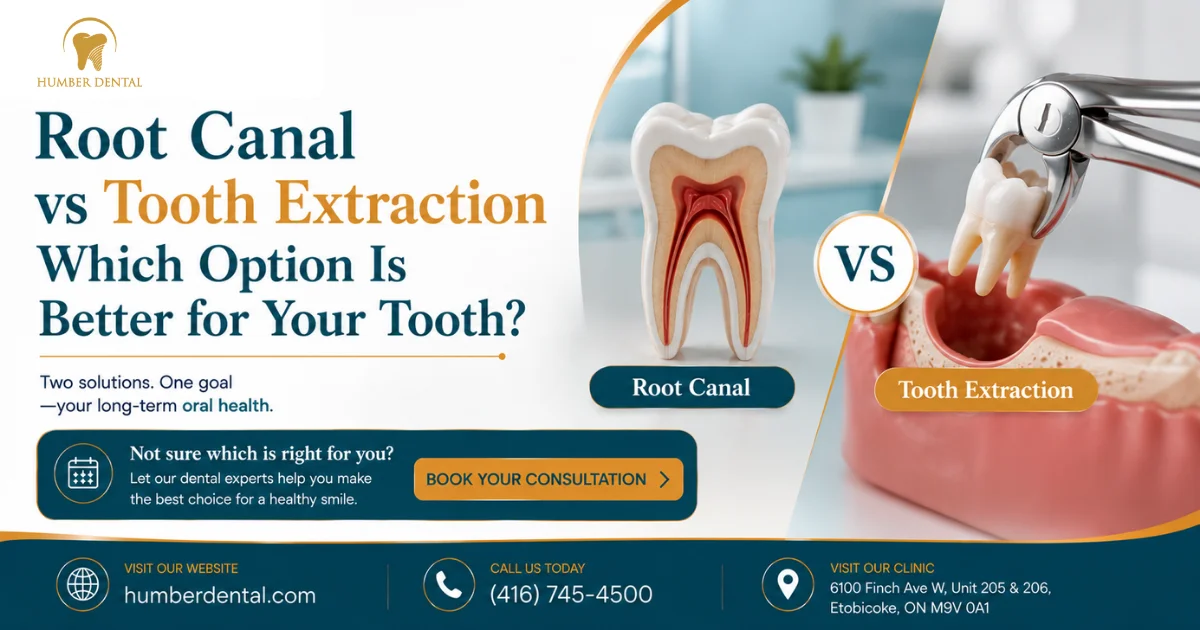
When a tooth is badly infected or damaged, you usually face a choice: save it with a root canal, or remove it and replace it. On the surface, pulling the tooth can look faster and cheaper. But that first impression misses the bigger picture, and the right answer depends on the tooth and on what happens next.
Here is a straight comparison of root canal vs extraction, so you can weigh both properly.
For most teeth that can be saved, a root canal is the better choice, because keeping your natural tooth protects your bite, your jawbone and your budget over time. Extraction is the right option when a tooth is too damaged to save, but a pulled tooth then needs replacing with an implant or bridge to avoid drifting teeth and bone loss. At Humber Dental in Etobicoke, we help you compare both openly. Call (416) 745-4500.
The Case for Saving Your Tooth
Nothing your dentist can add works quite as well as your own natural tooth. It is anchored in bone, it feels normal, and it keeps your bite and neighbouring teeth in their proper places. The main root canal benefits are that it clears the infection, relieves pain and lets you keep all of that, often for the rest of your life once the tooth is crowned.
Because it preserves the tooth and its roots, a root canal also protects the jawbone, which begins to shrink whenever a tooth is lost. For a tooth that can be saved, this is usually the better long-term outcome.
When Extraction Makes Sense
Extraction is the right call when a tooth is beyond saving, for example when it is split, severely broken below the gum, or when the bone support is too far gone. In those cases the tooth extraction benefits are real: it removes the source of infection and pain that cannot be resolved any other way, and it clears the path for a planned replacement.
The key point is that extraction is rarely the end of the story. A gap left behind needs a plan, because missing teeth cause their own problems.
Comparing Cost, Comfort and Long-Term Results
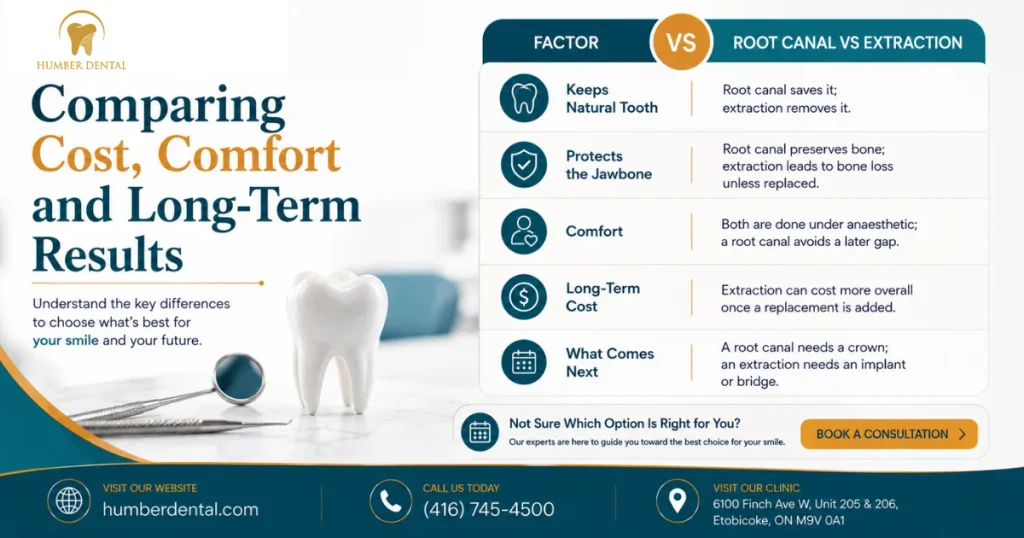
It helps to see the two options side by side.
| Factor | Root Canal vs Extraction |
| Keeps Natural Tooth | Root canal saves it; extraction removes it |
| Protects the Jawbone | Root canal preserves bone; extraction leads to bone loss unless replaced |
| Comfort | Both are done under anaesthetic; a root canal avoids a later gap |
| Long-Term Cost | Extraction can cost more overall once a replacement is added |
| What Comes Next | A root canal needs a crown; an extraction needs an implant or bridge |
What Happens After an Extraction
If a tooth does have to come out, replacing it protects the rest of your smile. Options include a dental implant, which stands alone and preserves bone, or a bridge that fills the gap using neighbouring teeth. Leaving a gap lets other teeth drift and the bite change over time. We plan replacement as part of the conversation, not an afterthought. For the full picture of costs on both paths, see our Etobicoke cost guide.
Read more: how much a root canal costs in Etobicoke
Not Sure Whether to Save or Remove Your Tooth?
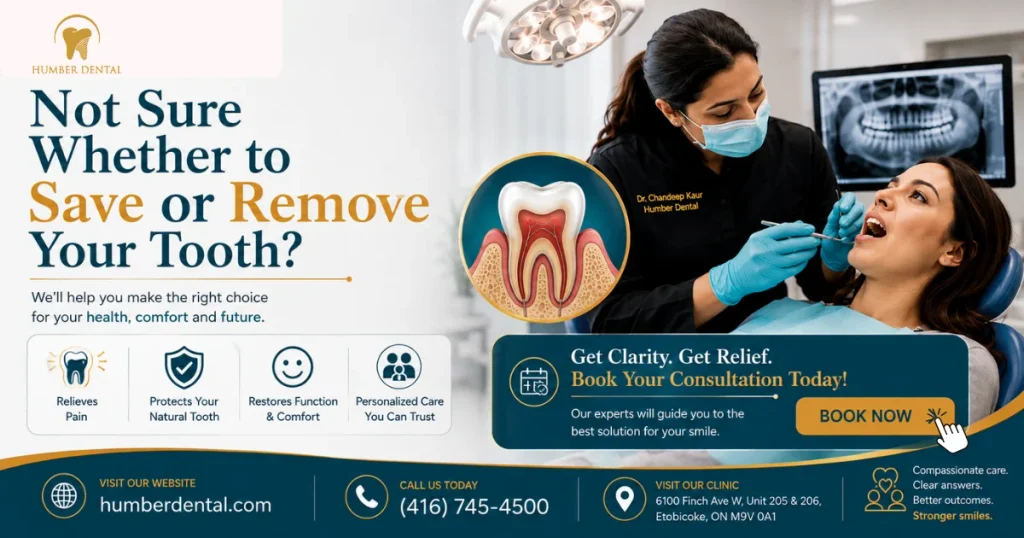
The best way to decide between a root canal and an extraction is a proper assessment. Humber Dental in Etobicoke will show you clearly whether your tooth can be saved, and explain the costs and options either way. Book online, or call or walk in.
Humber Dental | 6100 Finch Avenue W, Unit 205 & 206, Etobicoke, ON M9V 0A1
At Finch & Albion, in the Albion Finch Plaza. Free on-site parking. Call or Walk In: (416) 745-4500
FAQs About Root Canal vs Extraction
Q1. Is a root canal better than an extraction?
For a tooth that can be saved, yes. Keeping your natural tooth protects your bite, bone and budget, while an extraction leaves a gap that needs replacing. Extraction is best only when a tooth is too damaged to save. Call (416) 745-4500 for a straight assessment.
Q2. Is it cheaper to pull a tooth than to have a root canal?
Pulling a tooth can cost less upfront, but replacing it with an implant or bridge usually makes extraction more expensive overall. Saving the tooth is often the better value. We give you clear estimates for both. Call (416) 745-4500 to compare.
Q3. What are the downsides of tooth extraction?
A missing tooth lets neighbouring teeth drift, changes your bite and causes the jawbone to shrink, so it usually needs replacing. Extraction is the right choice only when a tooth cannot be saved. Book an assessment and we will explain your options.
Q4. How do I know if my tooth can be saved?
An exam with an X-ray shows how much healthy tooth and bone support remain, which determines whether a root canal can save it. Many teeth that feel hopeless can be saved. Call (416) 745-4500 and we will take a look.